
© 2026 ResonateTesting Ltd.
Before selecting a fluid, burner or rig, define what the test must prove. A development test may explore behaviour, reveal failure modes or compare design options. A qualification or certification test has a different burden. The specimen, configuration, operating condition, method, acceptance criteria and witnessing arrangements must match the approved programme requirements.
A successful exposure is not automatically certification evidence. Evidence becomes defensible when the test article and test configuration are traceable to the applicable approved or controlled design definition.
Matching pressure, flow, viscosity, density and temperature can reproduce selected hydraulic conditions. It does not by itself establish equivalent thermal decomposition, residue, seal response, coating attack, insulation effects, leakage development or post-fire condition. Where Skydrol chemistry forms part of the installation hazard, the specified grade should be used unless an alternative is justified and accepted through the programme’s approved route.
• Exact fluid family and grade, including condition and traceability.
• Operating pressure, flow and fluid temperature.
• Ambient temperature and pre-conditioning.
• Representative joints, seals, hoses, lines and installation interfaces.
• Component operation, load, stroke or actuator position.
• Leakage location, orientation and defined failure condition.
• Burner type, calibration, exposure, distance and specimen mounting.
• Pressure, temperature, displacement, flow and functional monitoring.
• Acceptance criteria, post-test inspection and retained evidence.
Fire Resistant and Fireproof can be defined equipment or installation performance requirements. Fluid marketing terminology must not be substituted for those definitions. The certification basis, product specification and approved test procedure determine the required classification and evidence. ISO 2685 provides a controlled fire-test method for equipment in designated fire zones, but it does not replace the applicable certification requirement or design-authority decision.
A development specimen can legitimately be non-production, modified, instrumented or intentionally non-conforming if the purpose and limitations are recorded. It can produce valuable engineering learning. It should not be presented as certification-level evidence unless the responsible authority accepts the configuration and any deviations.
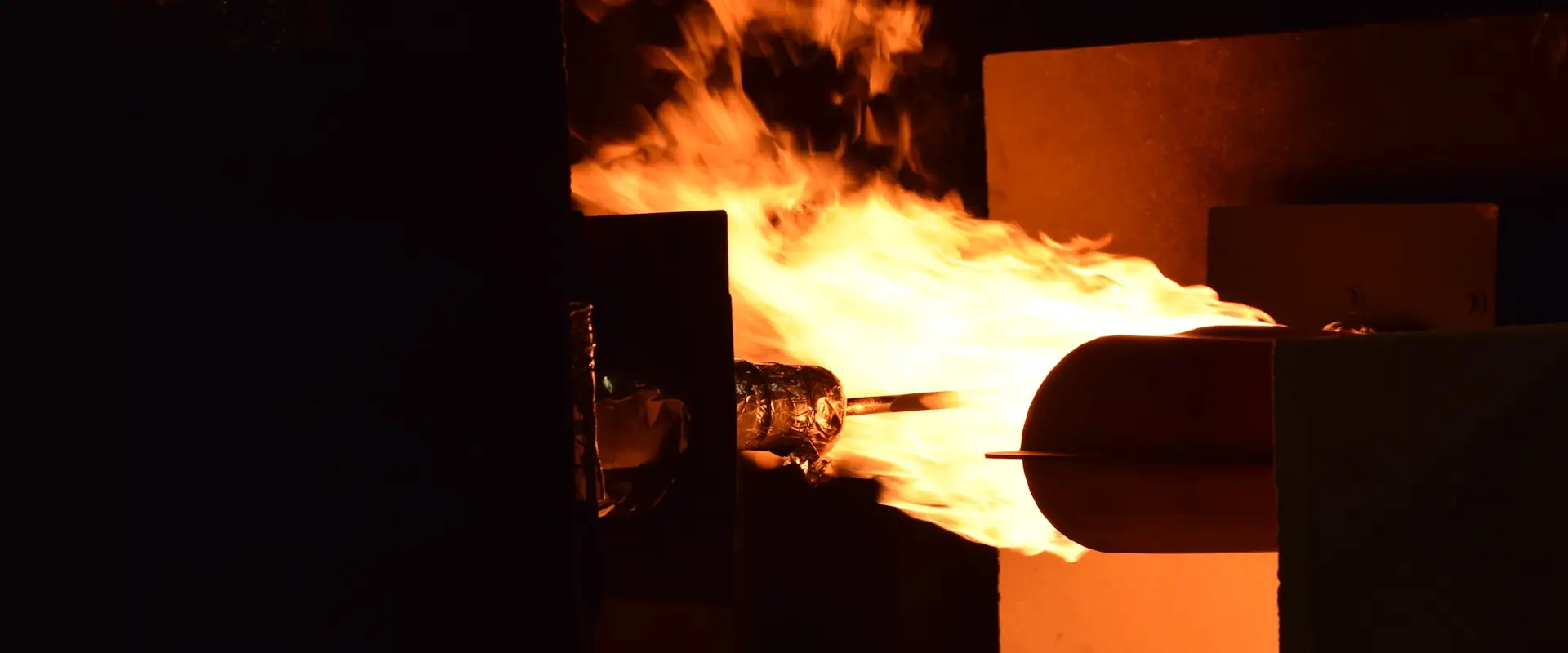
For certification-level work, the programme should establish that the test article is the article intended by the approved test plan. The exact route varies by authority and programme, but a robust conformity pack normally addresses:
Part number, dash number, serial number and modification state.
• Applicable drawing and specification revisions.
• Material and process traceability, including special processes where relevant.
• Assembly bill of material and approved deviations or concessions.
• Manufacturing and inspection records.
• Software and hardware configuration where applicable.
• Life status, previous use, repairs and rework.
• Instrumentation additions and their effect on the specimen.
• Photographic identification and physical marking.
• Conformity inspection status, witness requirements and authority acceptance.
EASA Form 1 and FAA Form 8130-3 can document an authorised release of an eligible article under the stated regulatory basis and status. Their blocks, remarks and release context matter. They are not universal certificates of aircraft installation approval and they do not replace test-article conformity to the certification configuration.
Form numbers, status and intended use must be checked against current EASA, FAA and programme procedures. Resonate should not issue or imply regulatory release documents unless specifically authorised to do so.
Passing a fire test does not, by itself, make a part fit for installation. Installation eligibility normally depends on an approved design definition and the aircraft, rotorcraft, engine or APU application. The evidence chain should answer all of the following:
Is the part number and modification state identified by the approved design data?
• Is that configuration included in the applicable assembly or installation bill of material?
• Is it shown on the relevant drawing, parts catalogue or other approved configuration record?
• Does the release documentation match the article, status and intended installation?
• Are life limits, maintenance instructions, software status and airworthiness limitations satisfied?
• Have all test deviations and failures been dispositioned by the responsible design or certification authority?
• Does the installation introduce interfaces or loads not represented by the test?
A part number appearing on a commercial or manufacturing BOM is not necessarily enough. The governing question is whether the part and configuration are included in, or otherwise approved by, the applicable approved design and installation data for the aircraft, helicopter, engine or APU.
Before quotation or test, Resonate should request the test specification, hydraulic schematic, fluid grade, operating envelope, installation drawing, specimen configuration index, acceptance criteria, conformity requirements, witnessing plan and reporting requirements. For certification-level testing, the customer must identify the responsible design organisation, certification authority or delegated representative and the required conformity route.
Resonate maintains specialist hydraulic and fire-test capability involving controlled pressure, fluid-temperature measurement, pressure monitoring, actuator-position measurement and configurable test arrangements. Each project remains subject to engineering review of the exact fluid, pressure, temperature, materials, cleanliness, fire configuration, instrumentation, safety controls and current accredited scope. Quantified capability limits must be approved before public release.
Test representativity has two parts. The environment must be representative, and the test article must be the correct controlled configuration. A representative fire applied to the wrong specimen produces the wrong evidence.
Your Test Facilitator. Not simply a test facility.
Where the hazard includes the chemical, thermal or material effects of Skydrol, the specified grade provides the most direct evidence. A surrogate may be acceptable only where the approved programme justifies it.
No. Those properties can reproduce selected hydraulic conditions but do not prove equivalent decomposition, material interaction, leakage or post-fire condition.
It is a specimen whose identity and configuration are controlled against the approved test plan and applicable design data, with the required conformity and witnessing evidence.
Potentially, if its configuration is shown to represent the approved certification configuration and any deviations are accepted through the applicable authority route. A prototype is not automatically unsuitable, but its status must be explicit.
Not by itself. It can provide authorised release and traceability evidence within its stated scope. The test programme must still establish conformity to the approved test configuration.
No. FAA Form 8130-3 is an authorised release or airworthiness approval document used in defined circumstances. Certification test conformity is established through the applicable conformity process and records.
No. A passed test is one element of the evidence. Installation also depends on approved design applicability, configuration, release status, limitations and the relevant aircraft, rotorcraft, engine or APU approval system.
For an installable production configuration, the part must be covered by the applicable approved design and configuration data. That may include an approved assembly or installation BOM and associated drawings. A test-only or development BOM is not enough.
The differences must be identified and assessed. The responsible design or certification authority decides whether the test remains representative, requires analysis, needs additional testing or is unsuitable as compliance evidence.
The approved programme defines this. It may involve the authority, an authorised representative, a delegated organisation, the design organisation, customer quality personnel or another agreed witness.
The simple answer is No. That is not within Resonate testing scope.
Provide the test specification, certification basis, fluid grade, schematic, operating envelope, specimen configuration, drawings, BOM reference, conformity plan, witness requirements and acceptance criteria.