
© 2026 ResonateTesting Ltd.
Resonate Testing supports lithium-ion battery fire and abuse programmes from cell and module level through to complete vehicle battery packs. Programmes can be planned to customer specifications and recognised standards, including testing that supports UN Regulation No. 100 evidence, homologation and type-approval activity.
Resonate supports lithium-ion battery fire and abuse programmes from individual cells and modules to complete packs and vehicle-integrated battery systems.
Programmes can include UN R100 Annex 9E external fire exposure, deliberate thermal-runaway initiation and thermal-propagation assessment under a customer specification or recognised standard. Methods, instrumentation, safety controls and required evidence are reviewed before execution.
Lithium battery fire testing is a controlled engineering assessment used to understand how lithium-ion cells, modules, battery packs and battery-powered systems behave when exposed to fire, heat or abuse conditions. The objective is to generate evidence about ignition risk, thermal runaway behaviour, propagation pathways and the effectiveness of containment or mitigation measures.
Testing may examine how a battery responds to an external fire exposure, how thermal runaway can be initiated, and whether a failure event remains contained or spreads to neighbouring cells or modules. Depending on the agreed programme, measurements can include temperature, voltage, current, gas generation, visual observations and post-test condition.
Resonate supports manufacturers, vehicle programmes, battery developers and approval teams with defined fire and abuse testing for cells, modules, complete packs and vehicle-integrated systems.
Programmes may support UN Regulation No. 100 evidence, homologation and type-approval activity. Resonate provides test evidence; it does not grant homologation or type approval.
Fit, handling, battery condition, hazards, equipment availability and post-test arrangements are confirmed through technical review.
Planning an external-fire, thermal-runaway or propagation programme? Share the chemistry, state of charge, energy, configuration, SDS, drawings and required evidence for engineer review.
An early technical review separates external-fire resistance, thermal-runaway initiation and propagation objectives.
Share the chemistry, state of charge, energy, drawings, SDS, target standard and required evidence.
Lithium battery fire testing is rarely governed by a single requirement. Most programmes sit within a wider framework of regulations, industry standards, customer specifications and approval pathways. The applicable combination depends on the battery application, target market, transport route, certification objectives and evidence required.
UN Regulation No. 100 (R100) is one of the most widely recognised frameworks for electric vehicle Rechargeable Electrical Energy Storage Systems (REESS). Within vehicle approval programmes, R100 addresses fire resistance alongside electrical, mechanical and environmental safety assessments. However, it represents only one part of the broader battery safety landscape.
Depending on the project, programmes may also reference standards and guidance such as:
UN 38.3 for battery transportation safety testing
IEC 62133-2 for portable rechargeable lithium batteries
IEC 62619 for industrial and energy-storage applications
IEC 62660 series for lithium-ion cells used in electric road vehicles
ISO 12405 for battery pack and system evaluation
SAE battery abuse and safety guidance documents
UL 9540A, UL 2580 or other application-specific fire and propagation references
Key principle: The objective is not simply to complete a prescribed test. The objective is to generate evidence that is relevant to the intended approval route, customer requirement and real-world application of the battery system.
| Standard / Guidance | Primary Focus | Typical Relevance to Testing |
|---|---|---|
| UNECE R100 | Electric vehicle battery safety requirements, including external fire resistance testing and thermal propagation assessment. | Used for EV and hybrid vehicle battery approval programmes. Commonly referenced for REESS fire resistance, thermal propagation, electrical safety and type-approval testing. |
| UN Manual of Tests and Criteria (UN 38.3) | International transport testing requirements for lithium and sodium batteries. | Required before lithium and sodium batteries can be shipped by air, road, rail or sea. Covers vibration, shock, altitude simulation, thermal cycling and short-circuit testing. |
| NFPA 855 | Fire protection requirements for stationary energy storage systems. | Referenced when evaluating battery energy storage system (BESS) fire hazards, thermal runaway risks, installation safety and mitigation measures. |
| UL 9540A | Test method for evaluating thermal runaway fire propagation within battery energy storage systems. | Used to assess cell-to-cell and module-to-module thermal runaway propagation, fire growth, gas generation and system-level fire behaviour. |
| IEC 62133-2 | Safety requirements for portable lithium-ion cells and batteries. | Commonly applied to consumer electronics, portable equipment and rechargeable battery products requiring evidence of electrical and environmental safety. |
| IEC 62619 | Safety requirements for industrial lithium battery systems and energy storage applications. | Applied to industrial batteries, energy storage systems, telecoms equipment, UPS systems and other stationary energy storage applications. |
| IEC 62660 Series / ISO 12405 | Performance, reliability and abuse testing for lithium-ion cells used in electric vehicles. | Used for EV cell qualification, abuse testing, thermal performance evaluation and durability assessment. |
| SAE J2464 / J2929 | Battery abuse and safety | — |
| EU Battery Regulation (EU) 2023/1542 | European requirements for battery safety, sustainability and lifecycle management. | Supports compliance planning, product approvals and market access within the European Union. |
UN Regulation No. 100 addresses electric power trains and rechargeable electrical energy storage systems (REESS) for category M and N road vehicles. Annex 9E assesses resistance to an external fuel-spill fire.
The sequence uses a gasoline pool-fire tray: ignition at least 3 m away, 60 seconds pre-burning, 70 seconds direct flame exposure, then a further 60 seconds using the specified screen—or without it where required. The device is then observed without extinguishing until its surface returns to ambient temperature.
The method and acceptance criteria must be checked against the applicable regulation revision. Thermal-runaway triggering is not automatically part of Annex 9E.
Resonate’s fire-rig capability
| Test approach | Gasoline pool-fire tray sized to the test unit |
|---|---|
| Maximum pack envelope | 1.3 m × 2.95 m |
| Maximum test-item mass | 2,200 kg |
| Screen arrangement | R100-pattern perforated screen bricks |
The R100 assessment set also includes vibration, thermal shock and cycling, mechanical shock, mechanical integrity or crush, external short circuit, overcharge, over-discharge, over-temperature and over-current protection. These can be discussed as part of a coordinated programme.
Battery transportation fire testing focuses on the performance of packaging systems, transport containers, insulation materials and containment solutions during representative battery failure events. Unlike battery pack fire testing, the emphasis is on whether the transport system can manage hazards such as flame, heat, gas release, projectile generation and loss of structural integrity while the battery is being stored or transported.
Programmes may support projects aligned with ADR transport requirements, battery transport container development, packaging validation and containment assessments for damaged, defective or thermal-runaway-prone batteries. Testing can be tailored to transport boxes, packaging materials, liners, insulation systems and enclosure concepts, with instrumentation and acceptance criteria agreed during technical review.
Related capability: Transport-material testing complements battery fire testing by evaluating the performance of the containment system around the battery rather than the battery alone.
Thermal runaway may be initiated by a variety of abuse conditions, including internal short circuits, overcharging, external heating, mechanical damage, and nail penetration.
Nail penetration testing is widely used to represent severe mechanical abuse by driving a conductive nail through a cell, which may create an internal short circuit. Depending on the cell chemistry, state of charge, and test conditions, this can result in rapid heat generation, cell venting, fire, or thermal runaway.
Assessing thermal runaway behaviour during nail penetration and other abuse tests supports the evaluation of battery safety and mitigation strategies.
Triggering methods are selected according to the specification, sample design, and required evidence.
The selected initiating cell or module, together with the trigger location, should be supported by documented justification, such as the worst-case thermal condition or the most probable propagation pathway.

Thermal runaway may be initiated by electrical overcharge, controlled external heating or another technically justified, specification-compliant method. The initiating cell or module should have a documented rationale based on the worst-case thermal scenario or likely propagation path.
Resonate Testing supports lithium-ion battery fire and abuse programmes from individual cells and modules through to complete vehicle battery packs. Testing programmes can be configured to generate evidence for fire resistance, thermal runaway initiation, propagation behaviour and containment performance under controlled conditions.
Capabilities are planned around the agreed specification, battery configuration, instrumentation requirements and safety objectives. Programmes can support customer-specific requirements, engineering validation activities and recognised standards including UN Regulation No. 100 fire resistance assessments.
Monitoring may include temperature, voltage and current, visual or functional monitoring, response measurements, advanced data acquisition, gas sampling and analysis where agreed, and photography or video where agreed.
| Specification | Capability |
|---|---|
| Fire resistance | External fuel-fire exposure testing aligned to agreed requirements |
| Thermal runaway | Initiation, monitoring and propagation assessment |
| Instrumentation | Temperature, voltage, current and advanced data acquisition |
A self-accelerating reaction within a battery cell where increasing temperature causes further heat generation. Depending on conditions, this may result in venting, fire, explosion or propagation to neighbouring cells.
The spread of a thermal runaway event from one cell to adjacent cells, modules or battery packs. Testing is used to assess containment effectiveness and propagation pathways.
A controlled fire applied to a battery system to assess resistance to external heat and flame exposure, including programmes aligned with UN R100 Annex 9E requirements.
The deliberate triggering of a failure event using an agreed abuse method such as external heating, overcharge, internal short-circuit simulation or mechanical damage.
The release of gases, vapours or electrolyte from a battery cell as pressure increases during abnormal operation or failure.
A severe mechanical abuse test in which a conductive nail is driven through a cell to investigate internal short-circuit behaviour, thermal runaway potential and fire risk.
The production of gases during battery failure, thermal abuse or thermal runaway. Gas composition and quantity may be monitored where included in the test programme.
Rechargeable electrical energy storage system.
Available charge relative to battery capacity.
The selected cell used to start a controlled event.
Battery fire testing is destructive and requires technical and hazard review. Chemistry, state of charge, energy, SDS information, known hazards and likely outcomes must be understood.
Sample preparation, fixture design, instrumentation, containment, storage, handling, transport, post-test condition and disposal arrangements are agreed before scheduling.
Wider UN R100 assessment may include vibration, thermal shock and cycling, mechanical shock, crush, external short circuit, overcharge, over-discharge, over-temperature and over-current protection.
Availability, method and accreditation status must be confirmed individually.
The agreed evidence pack may include:
Reporting provides objective evidence under defined conditions. Certification, type approval and pass/fail decisions are included only where formally agreed and supported by defined acceptance criteria.
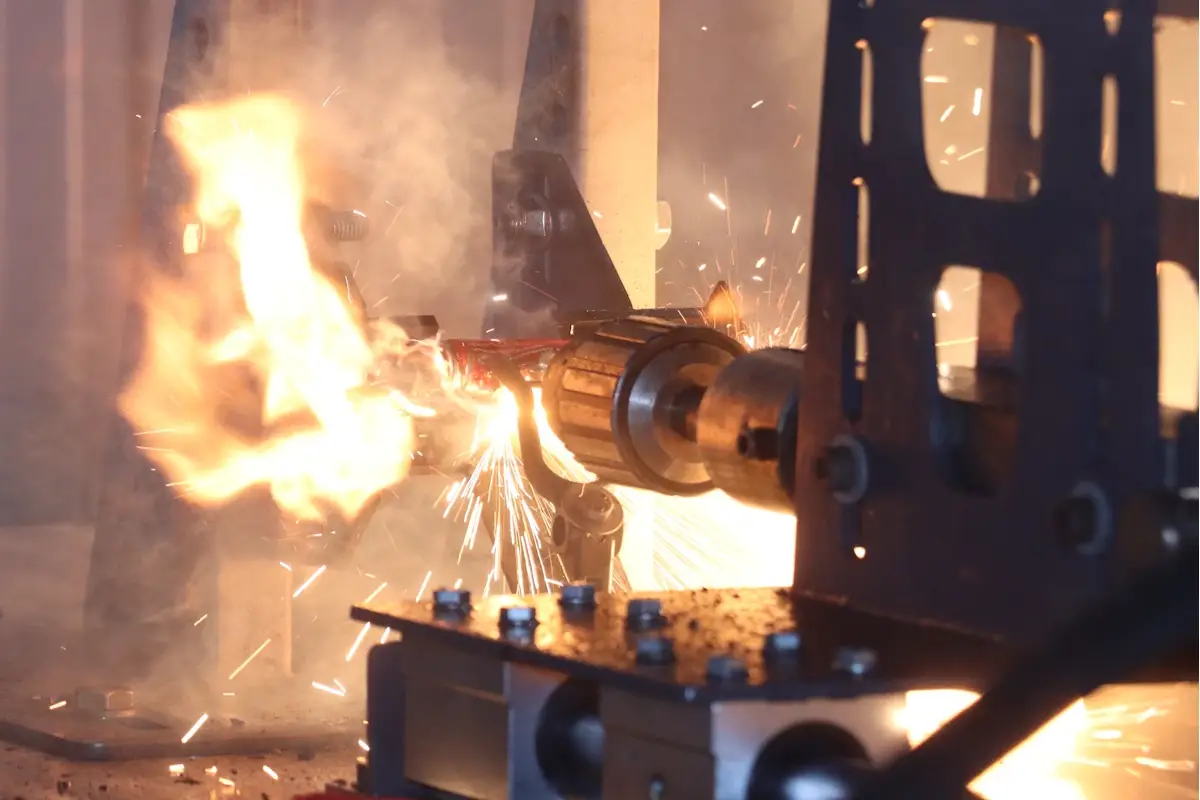
It assesses a rechargeable electrical energy storage system’s resistance to an external fuel-spill fire using the Annex 9E exposure sequence.
Not by default. Annex 9E is an external fuel-fire exposure. Thermal runaway initiation and propagation testing is complementary unless it is explicitly included in the agreed programme.
Programmes may cover lithium-ion cells, modules, complete packs and vehicle-integrated battery systems, subject to technical and hazard review.
Depending on the specification and approved test plan, triggering may use electrical overcharge, controlled external heating or another technically justified, specification-compliant method.
The initiating cell or module and trigger location should have a documented rationale, such as the worst-case thermal scenario or most likely propagation path.
What information is needed for a quotation?
Yes. Sample quantity, likely outcomes, post-test condition, handling and disposal arrangements should be agreed before testing.
The agreed pack may include the test method, setup description, monitoring summary, measurement data, plots, imagery, observations, deviations and anomalies.
Accreditation depends on the specific method, standard, test item, range and current UKAS schedule.
Share the chemistry, state of charge, energy, configuration, SDS, drawings, target method and required evidence. The team can review feasibility, rig fit, instrumentation and safety arrangements.
Whether you’re looking to contact us for the first time or have another testing requirement, we’d love to hear from you.