
© 2026 ResonateTesting Ltd.
Resonate Testing provides independent high-pressure proof, burst and cyclic pressure testing services for hydraulic hoses, tubing, manifolds, valves, actuators, accumulators and fluid system assemblies operating in demanding environments.
Our specialist pressure testing capabilities support product development, qualification, certification, production verification and failure investigations across aerospace, defence, energy, industrial, motorsport and specialist engineering sectors. Testing can be performed up to 50,000 psi (3,450 bar), providing valuable data on product strength, integrity, durability and safety margins.
Whether you need to demonstrate compliance with customer specifications, validate a new design or investigate a component failure, our engineers can develop a bespoke pressure testing programme tailored to your requirements.
Pressure testing is a verification and qualification process used to assess the strength, integrity, leak-tightness and long-term durability of components and systems that operate under internal pressure. It is widely used across aerospace, defence, energy, industrial, motorsport and research applications to demonstrate that products can safely withstand both normal operating pressures and extreme loading conditions.
Pressure testing can be performed on hydraulic hoses, tubing assemblies, valves, actuators, manifolds, accumulators, pressure vessels and complete fluid systems. Different test methods are used depending on the validation objective, ranging from leak and proof testing through to burst and fatigue life assessment.
Key forms of pressure testing include:
Modern pressure testing programmes are supported by high-accuracy instrumentation, continuous data acquisition and detailed engineering analysis to capture pressure profiles, leakage, cycle counts, temperature effects and failure events. This provides manufacturers with reliable evidence that products are safe, robust and capable of performing throughout their intended service life.
Pressure testing ultimately provides confidence that critical fluid system components will perform as intended under both routine operating conditions and unexpected pressure extremes, helping reduce risk, improve product reliability and support certification, qualification and production acceptance activities.
Modern hydraulic systems continue to operate at increasingly higher pressures to achieve greater power density, performance and weight reduction. Resonate’s high-pressure systems are designed to accommodate demanding qualification and validation programmes across a broad pressure range.
| Pressure Range | Typical Applications |
|---|---|
| Up to 5,000 psi | Industrial hydraulic systems |
| Up to 10,000 psi | Mobile equipment |
| Up to 15,000 psi | Heavy-duty hydraulic systems |
| Up to 20,000 psi | Aerospace hydraulic applications |
| Up to 30,000 psi | Defence hydraulic systems |
| Up to 50,000 psi | Ultra-high-pressure and research applications |
Testing can be conducted using hydraulic fluids, water-based media or customer-specified test fluids where appropriate.
Hydraulic systems used in aerospace applications operate within highly regulated and safety-critical environments. Failures can have significant operational and safety consequences, making robust qualification testing essential.
Resonate supports pressure testing programmes for:
Testing can be performed to customer specifications, aerospace standards and OEM qualification requirements.
Pressure testing is often performed to demonstrate compliance with industry, customer and regulatory requirements. Depending on the application, testing may be conducted to established aerospace, defence, hydraulic, pressure vessel and industrial standards, or to bespoke customer specifications.
Resonate supports pressure testing programmes developed around recognised international standards, OEM requirements and qualification procedures, helping manufacturers generate independent evidence of product safety, durability and performance.
Some Relevant Standards are:
| Standard / Guidance | Primary Focus | Typical Relevance to Testing |
|---|---|---|
| SAE AS1946 | Aerospace fluid system hoses and hose assemblies | Qualification testing of aerospace hydraulic hose assemblies, including proof, burst and cyclic pressure verification. |
| SAE AS1339 | Polytetrafluoroethylene (PTFE) hose assemblies for aerospace applications | Pressure qualification and acceptance testing of PTFE hose assemblies used in aircraft hydraulic, fuel and pneumatic systems. |
| SAE AS603 | Aerospace flexible hose assemblies | Verification of hose performance through proof pressure, burst pressure and pressure cycling tests. |
| SAE AS620 | Aerospace hydraulic tubing and hose system requirements | Pressure integrity and qualification testing of fluid conveyance systems operating in aerospace environments. |
| SAE J343 | Standard hydraulic hose and hose assembly test procedures | One of the most widely referenced standards for proof, burst, leakage, impulse and pressure cycle testing of hydraulic hoses. |
| SAE J517 | Hydraulic hose construction and performance requirements | Establishes minimum performance requirements that are typically verified through proof and burst pressure testing. |
| ISO 6803 | Hydraulic impulse and pressure cycling testing | Defines impulse and cyclic pressure testing methods to evaluate fatigue life and durability of hose assemblies. |
| ISO 6605 | Hydraulic hose assembly test methods | Covers burst, proof, leakage and dimensional evaluation of hydraulic hose assemblies. |
| EN 853 | Wire braided hydraulic hoses | Performance validation of hydraulic hoses, including pressure capability, proof testing and burst strength verification. |
| EN 856 | Wire spiral reinforced hydraulic hoses | Qualification of high-pressure hydraulic hoses through pressure integrity and burst testing. |
| EN 857 | Compact wire braided hydraulic hoses | Verification of pressure performance and pressure cycling durability of compact hydraulic hose products. |
| RTCA DO-160 | Environmental qualification of airborne equipment | Pressure testing is often performed alongside environmental, thermal, vibration and altitude testing to support aerospace qualification programmes. |
| MIL-STD / Military Specifications | Defence equipment qualification and verification | Pressure testing of hydraulic systems, hoses, actuators and fluid system components used in military platforms. |
| PED 2014/68/EU | European Pressure Equipment Directive | Pressure testing is commonly required to demonstrate compliance of pressure-containing equipment placed on the European market. |
| ASME BPVC Section VIII | Design and verification of pressure vessels | Hydrostatic proof testing and pressure integrity verification of pressure vessels and pressure-retaining components. |
| PD 5500 | Unfired fusion-welded pressure vessels | Pressure testing used to validate vessel integrity, design verification and regulatory compliance. |
| Customer & OEM Proprietary Specifications | Product-specific qualification requirements | Product-specific qualification requirements |
Aerospace hydraulic and fluid system components are frequently tested to support qualification, acceptance and certification programmes under standards such as:
Typical applications include hydraulic hoses, tubing assemblies, actuators, quick disconnect couplings, landing gear systems and flight control equipment.
Many proof, burst and cyclic pressure tests are conducted in accordance with fluid power industry standards, including:
| Standard | Description |
|---|---|
| ISO 6803 | Hydraulic impulse pressure testing of hose assemblies |
| ISO 6605 | Hydraulic hose assemblies and test methods |
| ISO 7751 | Wire-braid and spiral hydraulic hose testing |
| SAE J343 | Hydraulic hose and hose assembly testing procedures |
| SAE J517 | Hydraulic hose requirements and qualification |
| SAE J1405 | Hydraulic brake hose assembly testing |
| EN 853 / EN 856 / EN 857 | Performance requirements for hydraulic hoses |
For pressure-containing components, vessels and assemblies, testing may support compliance with:
| Standard | Description |
|---|---|
| ASME BPVC Section VIII | Pressure vessel design and verification |
| PD 5500 | Unfired fusion-welded pressure vessels |
| Pressure Equipment Directive (PED) 2014/68/EU | European pressure equipment compliance |
| BS EN 13445 | Unfired pressure vessels |
| API Specifications | Pressure-containing equipment used in oil & gas applications |
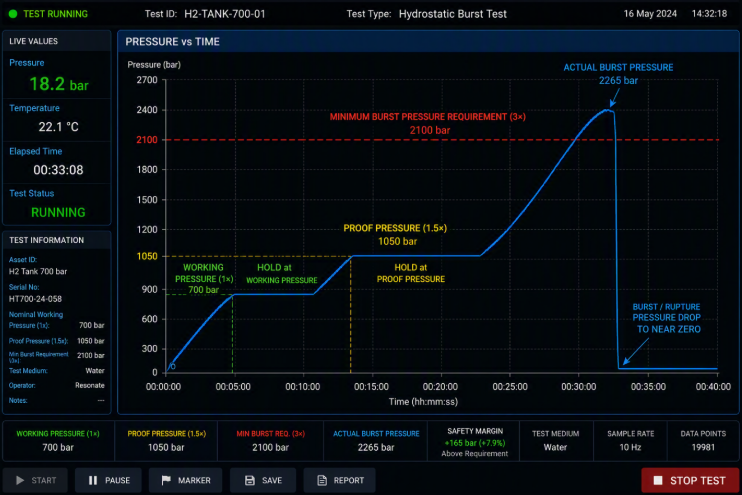
Pressure testing is widely used throughout industrial and energy sectors for design verification, qualification and production acceptance testing. Relevant standards may include:
Many pressure testing programmes are developed around customer-defined acceptance criteria rather than published standards. These may include:
Resonate can develop bespoke pressure testing programmes up to 50,000 psi (3,450 bar), combining proof, burst and cyclic testing to generate the evidence required for certification, qualification and product validation.
Accurate measurement and traceable data are critical to successful pressure testing programmes.
Our systems can provide:
Comprehensive test reports can include pressure profiles, hold periods, cycle counts, failure characteristics, acceptance criteria and test conclusions.
| Specification | Capability |
|---|---|
| Proof Pressure Testing | Verification that components can withstand specified proof pressures without leakage, deformation, structural damage or performance degradation. |
| Burst Pressure Testing | Determination of ultimate pressure capability and failure pressure under controlled loading conditions. |
| Cyclic Pressure Testing | Fatigue and durability assessment through repeated pressure cycling over thousands or millions of cycles. |
| Hydrostatic Pressure Testing | Pressure integrity verification using water or hydraulic fluid-based test media. |
| Leak Testing | Detection and measurement of leakage from seals, joints, fittings and pressure boundaries. |
| Failure Investigation Testing | Root cause analysis of pressure-related failures, leakage events and component ruptures. |
| Qualification Testing | Testing to aerospace, defence, industrial and customer-specific standards and specifications. |
| Production Acceptance Testing | Batch verification and acceptance testing for manufactured components and assemblies. |
| Custom Test Rig Development | Bespoke fixtures and test systems developed around unique customer requirements. |
| Instrumented Pressure Testing | Detailed monitoring of pressure, temperature, leakage, cycle counts and failure events. |
Resonate provides impartial pressure testing and engineering support for qualification, certification and failure investigation programmes.
Testing can be tailored to customer specifications, industry standards and unique operational requirements.
Testing up to 50,000 psi (3,450 bar) supports conventional hydraulic systems through to ultra-high-pressure applications.
Our engineers understand the qualification requirements associated with safety-critical and highly regulated industries.
Detailed engineering reports provide reliable, defensible data to support certification, compliance, design verification and product development activities.
Where known, provide:
| Parameter | Example |
|---|---|
| Working Pressure | 5,000 psi |
| Proof Pressure | 7,500 psi |
| Target Burst Pressure | 20,000 psi |
| Minimum Pressure | 500 psi |
| Maximum Pressure | 10,000 psi |
| Pressure Rise Rate | Customer specified |
| Hold Duration | 5 minutes |
| Required Number of Cycles | 1,000,000 cycles |
The ratio between a component’s failure pressure and its maximum intended working pressure.
An unfired pressure vessel is a closed container designed to hold gases or liquids at a pressure substantially different from ambient pressure and which is not subjected to direct firing or combustion-generated heat.
The period the vessel remains at test pressure. Typical values: 30 seconds, 1 minute, 5 minutes, 30 minutes, depending on the standard.
Burst strength remaining after damage, cycling, impact, fire exposure, or environmental conditioning. Used extensively for composite hydrogen tanks
A device that prevents dangerous over-pressure. Examples: Relief valve , Rupture disc or TPRD (Thermally Activated Pressure Relief Device)
Whether you are developing a new hydraulic component, qualifying aerospace flight hardware, validating a pressure vessel design or investigating an in-service failure, Resonate Testing can deliver independent pressure testing programmes that provide confidence in product safety, performance and reliability.
Whether you’re looking to contact us for the first time or have another testing requirement, we’d love to hear from you.