
UN R100 Testing | Electrical Vehicles, REESS

UN Regulation (R100): The Essential Guide to EV Powertrain and Battery Safety Testing Compliance

Resonate Testing supports EV manufacturers through development, qualification and certification evidence using UN R100 and customer-defined fire protection requirements for UK, Ireland and international programmes.

Your Test Facilitator. Not Simply a Test facility.

Resonate provides UN Regulation No. 100 type-approval safety testing for high-voltage traction batteries, REESS subsystems, and electric powertrain components. Our engineer-led battery testing capability supports manufacturers working to UN R100  with advanced abuse simulation and combined environmental instrumentation available for more representative validation programmes.

Not sure how to plan a UN R100 Safety test?

UN R100 compliance programmes often need early review of the REESS subsystem design, electrical isolation architecture, vehicle-level integration and acceptance criteria required by the vehicle type or certification route.

Share your pack description, CAD files, cell chemistry details, high-voltage bus specs, BMS telemetry interfaces, acceptance criteria and standard series revision. Resonate Testing can review environmental chamber setups, crash simulation fixturing, data acquisition instrumentation and reporting expectations before quotation.

  • UN R100 electrical safety and abuse simulation testing
  • REESS 03 series / 05 series compliance and type-approval review
  • Traction battery, electrical powertrain, and enclosure assessment
  • Multi-axis vibration, mechanical shock, thermal cycling and fire monitoring options
  • Development, homologation and type-approval certification support
Your Test Facilitator, Not Simply a Test Facility

UNECE R100 Testing

UN ECE R100 testing is essential for demonstrating that electric vehicle battery systems meet REESS (Rechargeable Electrical Energy Storage System) safety requirements for approval. By choosing Resonate Testing, manufacturers benefit from experienced battery test engineers, large-scale abuse and environmental capability, and practical guidance through test planning, execution and reporting for vehicle homologation programmes.

UN ECE R100 Facility capability

Resonate supports UN ECE R100 Part II testing for rechargeable electrical energy storage systems (REESS) used in electric vehicle approval and homologation programmes. Testing can be planned around the applicable revision of UN Regulation No. 100 and customer-specific requirements, covering mechanical durability, thermal exposure, fire resistance and electrical protection performance.

Typical programmes assess battery system behaviour, structural integrity, protection system response and safety performance under defined fault and abuse conditions. Test configuration, instrumentation, acceptance criteria and reporting outputs are reviewed against the intended vehicle application and approval route rather than treating the programme as a standardised battery test.
Specification Capability
Battery System Rechargeable electrical energy storage systems (REESS) used in electric vehicle approval and homologation programmes.
Mechanical Durability Vibration, mechanical shock and structural integrity testing to assess battery system robustness under vehicle operating conditions.
Thermal Exposure Thermal shock and temperature cycling to evaluate battery performance under changing environmental conditions.
Fire Resistance External fire exposure testing to assess REESS resistance to fire originating outside the vehicle.
Electrical Protection External short circuit, overcharge, over-discharge, over-temperature and over-current protection assessment.
Representative Conditions Test configuration, state of charge, instrumentation and monitoring aligned with the intended vehicle application and approval route.
Monitoring Voltage, current, temperature and protection system monitoring, with additional instrumentation agreed during test planning.
Pass/Fail Evidence Assessment against applicable UN ECE R100 requirements and agreed acceptance criteria, including protection response and safety performance.
Standards UN Regulation No. 100 Part II and customer-defined battery qualification or homologation requirements.
Additional Capability Thermal runaway, propagation, battery abuse, environmental and pre-compliance testing programmes.
Test Planning Support Technical review, annex selection, instrumentation planning, safety controls, witness requirements and reporting scope definition.
Reporting Outputs Technical reports, test data, observations and evidence packages agreed before testing begins.

How a UN R100 safety test campaign works

  1. Plan: Review the standard, vehicle category, electrical architecture, acceptance criteria and isolation baselines.
  2. Prepare: Confirm fixtures, crash/crush simulation rigs, environmental chambers, BMS telemetry interfaces and instrumentation needs.
  3. Mount and instrument: Install the REESS subsystem, connect agreed data acquisition channels and verify safe isolation resistance before abuse exposure.
  4. Calibrate and expose: Confirm rig conditions, then run the specified mechanical or electrical stress test at the agreed parameters.
  5. Monitor: Record isolation resistance, cell temperatures, voltages, visual observations and any structural or leakage checks required by the plan.
  6. Review and report: Assess post-test integrity, isolation metrics, observations, photographs, plots and agreed outputs for homologation type approval.

What to Provide Before a UNECE R100 Quotation?

To prepare an accurate UNECE R100 quotation, the test laboratory should review the battery system design, intended test scope and approval requirements before confirming sample quantities, instrumentation and programme duration. Information supplied at enquiry stage helps identify the applicable annex tests, safety controls and evidence package required for the programme.

Typical information requested includes:

  • REESS / battery pack drawings and datasheets
  • Cell chemistry and electrolyte details
  • Voltage, capacity (Ah) and energy (kWh)
  • Overall dimensions and mass
  • Installation orientation and vehicle application
  • Required UNECE R100 revision
  • Required annex tests and any additional OEM requirements
  • State of charge (SOC) for testing
  • Instrumentation and monitoring requirements
  • Safety Data Sheet (SDS) and battery hazard information
  • Witness testing or photographic evidence requirements
  • Reporting and homologation evidence requirements

Early technical review helps confirm feasibility, sample requirements, monitoring arrangements and acceptance criteria before valuable prototype hardware is committed to formal testing.

UN R100 Battery Safety Testing Terminology

Thermal propagation

The sequential occurrence of thermal runaway within a REESS triggered by thermal runaway of a single cell.

Thermal runaway

An uncontrolled increase of cell temperature caused by exothermic reactions inside the cell.

Live parts

The conductive part(s) intended to be electrically energized under normal operating conditions.

Rechargeable Electrical Energy Storage System (REESS)

The rechargeable energy storage system that provides electric energy for electrical propulsion (excluding auxiliary batteries for starting or lighting).

C-Rate

Defined as the constant current of the Tested-Device, which takes 1/n hours to charge or discharge the device between 0% and 100% state of charge.

State of Charge (SOC)

The available electrical charge in a Tested-Device expressed as a percentage of its rated capacity.

Battery abuse and thermal runaway expertise

Alongside UN ECE R100 testing, Resonate supports deeper battery safety and abuse programmes at cell, module and pack level.

  • Thermal runaway and propagation testing

  • Cell, module and battery pack abuse testing

  • Fire testing

  • Overcharge, crush and nail penetration studies

  • IEC 62619 and RTCA DO-311A testing

Battery Testing Standards and related testing services

Fast. Flexible. Accessible.

What you will recieve after you UNECE R100 Test?

The outputs, evidence requirements and reporting format should be agreed before testing begins. This helps ensure the programme delivers the information needed to support engineering decisions, validation activities and homologation objectives.

Following completion of the agreed UN ECE R100 test programme, deliverables can include:

  • Detailed technical test reports covering the completed Annex testing programme.
  • Recorded mechanical, thermal, fire and electrical protection test data.
  • Assessment of REESS behaviour and protection system performance against agreed acceptance criteria.
  • Test setup, instrumentation and monitoring records.
  • Agreed photographic evidence captured throughout the test programme.
  • Technical observations relating to battery safety, protection response and system behaviour.
  • Post-test inspection findings and condition assessment of the REESS where applicable.
  • Additional reporting from pre-compliance, abuse or thermal runaway investigations where these activities have been included within the agreed scope.
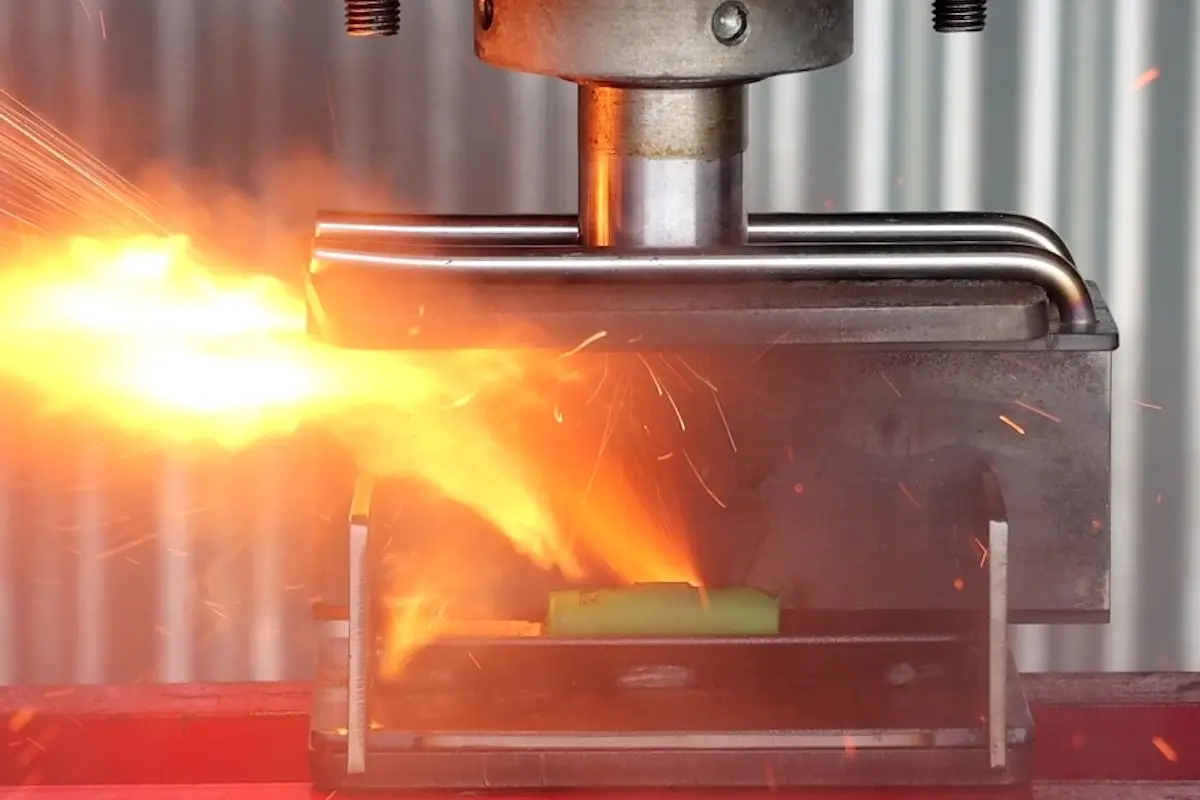
Battery cell undergoing a crush test, representing battery safety and abuse testing under extreme mechanical conditions.

UN R100 testing FAQs

Scope

Approval

Testing

Send your UN R100 test requirement for engineer review

Book safety and abuse validation testing for REESS subsystems, traction batteries, enclosures, high-voltage powertrains and electrical components. Use the contact route to share your standard, drawings, operating conditions and acceptance criteria for review.

Contact Form

Whether you’re looking to contact us for the first time or have another testing requirement,  we’d love to hear from you.