Introduction
Every spacecraft contains materials whose behaviour changes when exposed to the vacuum, temperature extremes, radiation and operating conditions encountered during a mission.
At sea level, molecules released from a material do not travel far because they undergo frequent collisions with air molecules, leading to rapid dispersion and dilution into the atmosphere. These collisions limit the mean free path, defined as the average distance a molecule travels before colliding with another molecule.
In a high-vacuum environment, the reduced ambient pressure both increases the tendency of volatile constituents to be released from materials and substantially increases the mean free path. As a result, released molecules can travel considerable distances before colliding with another molecule.
This release process is known as outgassing. Released molecules can migrate through the spacecraft, encounter other surfaces, re-emit, react with the space environment or condense on colder hardware. The resulting molecular contamination can degrade hardware like star trackers, telescope optics, thermal-control surfaces, radiators, solar-cell cover glasses, filters and cryogenic detectors.
The key engineering question is therefore not simply whether a material outgasses. Nearly all materials release something under appropriate conditions. The important questions are: how much material outgasses, which molecules are present, whether they deposit on a sensitive surface and whether there is any measurable change in performance.
Contamination control is therefore an end-to-end engineering discipline. It connects materials selection, manufacturing processes, cleanliness management, molecular transport analysis, environmental verification, bakeout, thermal vacuum exposure and flight-readiness evidence.
ECSS-Q-ST-70-01 addresses cleanliness and contamination control, while ECSS-Q-ST-70-02 addresses thermal vacuum outgassing screening of space materials. ECSS-E-ST-10-04 provides space-environment information, including molecular contamination sources and transport considerations.
What Is Outgassing?
Definition
Outgassing is the release of absorbed, adsorbed, dissolved, trapped or degradation-generated molecular species from a material.
Typical released species can include:
-
Water vapour
-
Residual solvents
-
Hydrocarbons
-
Plasticisers
-
Unreacted monomers
-
Lubricant fractions
-
Siloxanes
-
Cleaning residues
-
Process chemicals
-
Material-degradation products
Outgassing should not be confused with leakage.
A leak introduces gas through an unintended opening, imperfect seal or permeable boundary. Outgassing originates from the material, surface or manufacturing process itself.
The Engineering Definition
A contamination engineer treats outgassing as a contamination source term, not merely as an isolated material property.
The basic question is not:
Does this material outgas?
The useful engineering questions are:
-
What species are released?
-
At what rate are they released?
-
How does the rate change with time and temperature?
-
What quantity of material is present?
-
Where is the source located?
-
Which surfaces have direct or indirect molecular view?
-
What proportion reaches a sensitive surface?
-
Does the contaminant remain, react or re-emit?
-
What performance change could result?
-
Does the predicted deposition remain within the contamination budget?
A standard material-screening result is therefore one input into contamination engineering. It is not a complete spacecraft-level contamination assessment.
Space Environment Fundamentals
Sea-Level and Space-Vacuum Behaviour
| Characteristic | Sea-level environment | Space-representative vacuum |
|---|---|---|
| Pressure | Approximately 101.3 kPa | Very low and mission-dependent |
| Gas convection | Present | Negligible in external vacuum |
| Molecular collisions | Frequent | Infrequent |
| Molecular transport | Dominated by gas interactions and airflow | Can enter free molecular flow |
| Moisture behaviour | Adsorption and absorption remain significant | Desorption and migration can increase |
| Volatile loss | Often slower or less apparent | Can become significant |
| Heat transfer | Conduction, convection and radiation | Conduction and radiation dominate |
| Contamination movement | Influenced by airflow and handling | Influenced by geometry, view factors and surface interaction |
| Cold-surface deposition | Less dominant | Can become mission critical |
Why Vacuum Changes Molecular Transport
At atmospheric pressure, gas molecules undergo frequent collisions. Released species interact with air, surfaces and local fluid movement.
As pressure decreases, the mean free path increases. When that path becomes large compared with the characteristic dimensions of the system, the environment enters the free molecular flow regime.
Under free molecular flow:
-
Molecules can travel ballistically between surfaces.
-
Airflow no longer controls contaminant movement.
-
Geometric line of sight becomes important.
-
Reflections from intermediate surfaces can matter.
-
Surface temperature strongly affects residence time.
-
Cold surfaces can act as molecular sinks.
-
A source and affected surface can be physically separated.
This is why contamination control cannot be reduced to keeping a visibly clean chamber. Molecular contamination may be present even when no visible deposit exists.
Space Is Not One Uniform Vacuum
Pressure, temperature and contamination behaviour vary according to:
-
Orbit
-
Altitude
-
Spacecraft configuration
-
Venting
-
Local plumes
-
Release mechanisms
-
Material temperature
-
Sunlight exposure
-
Ram and wake direction
-
Mission duration
-
Neighbouring hardware
Ground-based TVAC testing provides controlled environmental exposure. It does not reproduce every aspect of the in-orbit molecular environment.
The Science of Outgassing
Surface Desorption
Materials exposed to the atmosphere develop adsorbed molecular layers. Water is particularly common, but hydrocarbons, cleaning residues and process contaminants can also attach to surfaces.
Under vacuum, some of these molecules acquire sufficient energy to leave the surface. Desorption can dominate the early stages of pump-down.
Bulk Diffusion
Volatile species can exist within the bulk of a polymer or porous material.
Examples include:
-
Residual solvents
-
Trapped process chemicals
-
Unreacted monomers
-
Plasticisers
-
Moisture
-
Low-molecular-weight additives
These species migrate towards the surface before being released. Diffusion-controlled outgassing can continue after surface species have largely been removed.
Evaporation and Sublimation
Every material has a temperature-dependent vapour pressure.
A volatile liquid may evaporate, while some solid constituents can sublime directly into vapour. Reduced ambient pressure increases the net escape of molecules because fewer return from the surrounding environment.
Material Degradation
Outgassed species are not limited to compounds originally present in the material.
Heat, radiation, atomic oxygen, electrical discharge, incomplete curing and chemical instability can create lower-molecular-weight products with higher volatility. Contamination behaviour can therefore change throughout mission life.
Temperature Dependence
Temperature affects:
-
Molecular mobility
-
Diffusion rate
-
Vapour pressure
-
Desorption rate
-
Chemical reaction rate
-
Surface residence time
-
Re-emission probability
Many release mechanisms exhibit Arrhenius-type temperature dependence. Increasing temperature can accelerate diffusion and desorption.
This is the scientific basis of bakeout. Heat and vacuum are used together to remove volatile species under controlled ground conditions.
However, the relationship is not simply “higher temperature equals better bakeout”. Temperature must remain within material, component and hardware limits. Excessive heating can damage the hardware, alter materials or generate additional decomposition products.
Outgassing and Molecular Contamination
Outgassing and contamination are related but different.
| Term | Meaning |
|---|---|
| Outgassing | Release of molecular species from a material or surface |
| Transport | Movement of released molecules through the environment |
| Deposition | Arrival and retention of molecules on another surface |
| Contamination | Unwanted material present on a surface or within an environment |
| Degradation | Resulting change in optical, thermal, electrical or mechanical performance |
Outgassing is a source mechanism.
Contamination is a possible consequence.
Not every released molecule reaches a critical surface. Some molecules are pumped away, vented to space, deposited on non-critical surfaces or re-emitted.
A defensible assessment therefore considers the complete chain:
Source → Release rate → Transport → Surface interaction → Accumulation → Performance effect
Molecular Transport Engineering
Source Characterisation
The source term may require information on:
-
Material identity
-
Material quantity
-
Exposed surface area
-
Cure condition
-
Temperature history
-
Outgassing rate
-
Species composition
-
Release duration
-
Material ageing
-
Previous vacuum exposure
Screening data that omit these factors may be too conservative, insufficiently representative or unsuitable for detailed mission modelling.
Geometric View Factors
A molecular view factor describes the geometric relationship between a source and a receiving surface.
The assessment can include:
-
Direct line of sight
-
Indirect paths
-
Reflections from surrounding structures
-
Vent paths
-
Apertures
-
Baffles
-
Shields
-
Relative orientation
A surface without direct view can still receive contamination through reflected or re-emitted molecular paths.
Sticking and Residence Time
When a molecule reaches a surface, it may:
-
Remain on the surface
-
Re-emit almost immediately
-
Remain temporarily and later re-emit
-
React chemically
-
Become fixed by radiation or atomic oxygen
-
Migrate across the surface
The outcome depends on the contaminant, receiving material and surface temperature.
Cold surfaces generally produce longer residence times. Cryogenic surfaces can therefore collect species that would rapidly leave a warmer surface.
Monte Carlo Molecular Modelling
Monte Carlo methods can simulate large numbers of molecular trajectories through a spacecraft geometry.
Potential outputs include:
-
Deposition maps
-
Surface fluxes
-
Time-dependent accumulation
-
Source contribution analysis
-
Contamination rates
-
Sensitivity to temperature or geometry
-
Inputs to optical and thermal performance assessments
Monte Carlo modelling is not automatically required for every programme. It becomes most valuable where the geometry is complex, surfaces are highly sensitive or simple bounding calculations cannot demonstrate compliance.
Model Limitations
A complex model is not automatically a reliable model.
Useful contamination models require:
-
Traceable source data
-
Defined assumptions
-
Validated geometry
-
Realistic temperatures
-
Appropriate sticking behaviour
-
Sensitivity analysis
-
Experimental correlation where practical
-
Clear treatment of uncertainty
-
Conclusions restricted to the model scope
How Molecular Contamination Affects Mission Performance
Star Trackers
Deposits on windows, lenses, baffles or detectors can cause:
-
Reduced transmission
-
Increased scatter
-
Higher stray-light levels
-
Reduced star-detection margin
-
Calibration change
-
Reduced attitude-determination performance
The effect depends on deposit thickness, optical properties, wavelength and instrument design.
Telescopes and Imaging Payloads
Molecular films can alter:
-
Reflectivity
-
Transmission
-
Scatter
-
Wavefront quality
-
Detector response
-
Calibration stability
Ultraviolet instruments can be particularly sensitive because thin organic deposits may cause significant transmission loss and can become more difficult to remove after radiation exposure.
Infrared and Cryogenic Instruments
Cryogenic surfaces can act as efficient molecular collectors.
Potentially affected surfaces include:
-
Detector windows
-
Focal planes
-
Filters
-
Mirrors
-
Cold shields
Possible effects include:
-
Sensitivity loss
-
Spectral distortion
-
Increased background
-
Calibration drift
-
Reduced science return
The risk is especially serious where the contaminated surface cannot be warmed or cleaned without disrupting the mission.
Solar Arrays
Contamination on solar-cell cover glasses or associated optical surfaces can reduce the light reaching the active cell.
The actual effect depends on:
-
Deposit composition
-
Film thickness
-
Wavelength-dependent absorption
-
Radiation exposure
-
Cell and cover-glass design
-
Surface temperature
Contamination should not automatically be assumed to cause major power loss. The effect must be assessed against the mission design and contamination budget.
Thermal-Control Surfaces
Contamination can change:
-
Solar absorptance, α
-
Infrared emittance, ε
-
The α/ε ratio
-
Radiator efficiency
-
Equilibrium temperature
Consequences may include:
-
Thermal-model mismatch
-
Increased heater demand
-
Reduced thermal margin
-
Unexpected component temperature
-
Greater operational constraints
Mechanisms and Precision Hardware
Deposits or volatile loss can affect:
-
Lubrication
-
Friction
-
Bearing behaviour
-
Optical encoders
-
Release mechanisms
-
Precision interfaces
The risk depends on both contamination deposition and the loss of essential volatile constituents from the original material.
Material-Screening Metrics
Total Mass Loss
Total Mass Loss, or TML, measures the percentage of original specimen mass lost during the defined screening exposure.
TML provides an indication of overall volatile loss. It does not identify the released species or determine where they will deposit.
Recovered Mass Loss
Recovered Mass Loss, or RML, accounts for mass regained by the specimen following the defined recovery condition.
It helps distinguish recoverable water-related mass loss from more permanent material loss.
Collected Volatile Condensable Material
Collected Volatile Condensable Material, or CVCM, measures the material collected on a controlled collector during the screening test.
CVCM is particularly relevant to contamination-sensitive applications because it indicates that part of the released material can condense under the defined test conditions.
However, CVCM does not fully reproduce:
-
Mission geometry
-
Mission temperatures
-
Mission duration
-
Actual source quantity
-
Real surface chemistry
-
Radiation exposure
-
In-flight re-emission
Water Vapour Regained
Water Vapour Regained, or WVR, represents the mass regained through moisture uptake under the defined recovery conditions.
It supports interpretation of the relationship between water release and permanent volatile loss.
Why Screening Data Need Context
A pass against a general screening criterion does not automatically mean that a material is suitable for every mission.
The decision may also depend on:
-
Quantity used
-
Position
-
Direct or indirect view
-
Sensitive-surface temperature
-
Optical wavelength
-
Mission lifetime
-
Cure process
-
Batch or formulation
-
Age of the screening data
-
Customer-specific limits
The 2025 revision of ECSS-Q-ST-70-01 applies different outgassing criteria according to material quantity, temperature and proximity to contamination-sensitive or cryogenic surfaces.
Silicone Contamination
Why Silicones Receive Special Attention
Silicone materials can provide valuable properties, including:
-
Thermal stability
-
Flexibility
-
Electrical insulation
-
Sealing performance
-
Processability
Potential sources include:
-
Room-temperature vulcanising compounds
-
Sealants
-
Potting materials
-
Conformal coatings
-
Elastomers
-
Lubricants
-
Release agents
The risk arises from specific volatile silicone-derived species, material formulation, cure condition, application and proximity to sensitive surfaces.
Silicones should not be treated as universally unacceptable. Equally, they should not be approved solely because another silicone product has satisfactory heritage.
Why Deposited Silicone Species Matter
Deposited silicone-derived material can be difficult to remove. Exposure to ultraviolet radiation or atomic oxygen may convert deposited species into more persistent silicon-containing residues.
Programmes involving sensitive optics, ultraviolet instruments or contamination-critical surfaces may therefore require:
-
Product-specific data
-
Controlled curing
-
Restricted application
-
Additional screening
-
Location controls
-
Bakeout
-
Witness samples
-
Customer approval
Bakeout Engineering
What Is Bakeout?
Bakeout is a controlled thermal process used to accelerate the removal of volatile species before flight or contamination-sensitive testing.
The process may be performed:
-
In vacuum
-
Under controlled purge
-
At material level
-
At component level
-
At subassembly level
-
On integrated hardware
Vacuum bakeout encourages released material to leave the hardware rather than redeposit locally. Cold traps or cryopanels may be used to collect evolved contaminants.
Why Bakeout Works
Bakeout combines:
-
Increased molecular mobility
-
Increased vapour pressure
-
Accelerated diffusion
-
Accelerated desorption
-
Controlled removal from the environment
The objective is to remove volatile species on the ground rather than allow uncontrolled release in orbit.
Bakeout Is Not a Universal Remedy
Bakeout does not:
-
Make every unsuitable material suitable
-
Replace material screening
-
Correct prohibited-material use
-
Guarantee zero future outgassing
-
Remove every deeply trapped volatile
-
Prove spacecraft-level contamination compliance by itself
Defining a Bakeout
A controlled bakeout may require:
-
Defined hardware configuration
-
Cleanliness controls
-
Temperature limits
-
Pressure or purge conditions
-
Heating and cooling rates
-
Duration
-
Instrumentation
-
Chamber background assessment
-
QCM or witness monitoring
-
Stopping criteria
-
Post-bakeout handling
-
Reporting and traceability
The bakeout duration should not be selected arbitrarily. It should be based on the requirement, hardware response, monitoring result or approved stopping criterion.
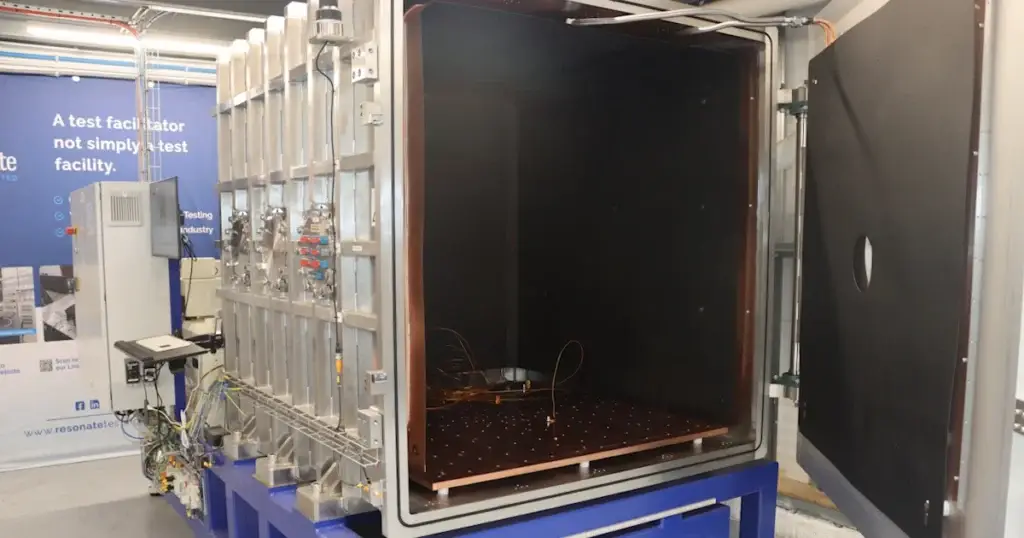
Thermal Vacuum Testing and Verification
Thermal vacuum testing exposes hardware to controlled vacuum and temperature conditions.
A TVAC campaign may assess:
-
Survival under vacuum
-
Hot and cold operation
-
Thermal cycling
-
Functional performance
-
Interface behaviour
-
Thermal stability
-
Material response
-
Outgassing concerns
-
Contamination control
-
Qualification or acceptance evidence
TVAC Is Not the Same as Material Screening
ECSS-Q-ST-70-02 material screening uses a defined specimen-level method and metrics.
Hardware TVAC testing evaluates an assembled item under a project-specific environmental profile.
The two activities can support the same contamination-control programme, but they do not provide interchangeable evidence.
Contamination Control During TVAC
A contamination-aware TVAC campaign can require:
-
Approved Declared Materials List
-
Chamber cleaning procedures
-
Chamber background evidence
-
Controlled pump-down
-
Clean repressurisation
-
Approved fixtures and cabling
-
QCM or witness positioning
-
Temperature control
-
Hardware inspection
-
Contamination limits
-
Anomaly handling
-
Traceable as-run records
The facility, fixture, instrumentation and support equipment can themselves become contamination sources. Chamber suitability must therefore be assessed rather than assumed.
Contamination-Monitoring Technology
Residual Gas Analysis
A Residual Gas Analyser identifies gas species and their partial pressures within a vacuum system.
It can support:
-
Leak investigation
-
Vacuum-quality assessment
-
Water monitoring
-
Hydrocarbon detection
-
Process observation
-
Identification of changing gas composition
-
Investigation of possible contamination sources
An RGA does not directly measure the total mass deposited on a sensitive surface. It should not be treated as a substitute for QCM or witness methods where condensable contamination must be quantified.
Quartz Crystal Microbalance
A Quartz Crystal Microbalance detects very small changes in deposited mass through changes in the resonant frequency of a quartz crystal.
A temperature-controlled QCM can help assess deposition at a representative surface temperature.
Interpretation depends on:
-
Crystal location
-
View factor
-
Crystal temperature
-
Background deposition
-
Sensitivity
-
Calibration
-
Re-evaporation
-
Representativeness of the protected surface
Witness Samples
Witness samples collect contamination during a defined activity.
They can support:
-
Post-test deposition assessment
-
Molecular contamination analysis
-
Optical-property measurement
-
Chemical identification
-
Comparison with acceptance limits
The witness material, position, temperature, exposure duration and analysis method must be relevant to the protected surface.
Complementary Use
RGA, QCM and witness samples answer different questions:
| Technique | Primary question |
|---|---|
| RGA | Which gas species are present in the chamber? |
| QCM or TQCM | How much material is depositing at the monitored location and temperature? |
| Witness sample | What accumulated on a representative surface, and what are its properties? |
Contamination Risks for New Space Programmes
Accelerated Schedules
Short development cycles can compress:
-
Materials review
-
Supplier-data assessment
-
Cleanliness planning
-
Screening
-
Bakeout
-
TVAC preparation
-
Anomaly investigation
-
Verification closure
The correct response is not to remove contamination engineering. It is to start earlier, focus on the highest-risk items and define evidence requirements before integration.
Commercial Off-the-Shelf Hardware
COTS hardware may have:
-
Limited material disclosure
-
Changing formulations
-
Unknown adhesives
-
Uncontrolled lubricants
-
Incomplete vacuum data
-
Limited batch traceability
-
Terrestrial rather than space heritage
COTS does not automatically mean unsuitable. It means that suitability must be established for the intended mission and environment.
Additive Manufacturing
Additively manufactured parts can introduce concerns involving:
-
Porosity
-
Trapped powder
-
Support-material residue
-
Cleaning chemicals
-
Surface treatments
-
Polymer feedstock
-
Post-processing
-
Internal cavities
-
Batch variability
The verification need depends on material, process, geometry, post-processing and application. Additional testing is not automatically mandatory in every case, but unsupported assumptions are a poor substitute for evidence.
Limited Contamination Budgets
Smaller programmes may not have a dedicated contamination-control engineer.
A proportionate approach should still identify:
-
Sensitive surfaces
-
Major material sources
-
Direct molecular view
-
Cold surfaces
-
Customer limits
-
Screening gaps
-
Cleaning and bakeout needs
-
Required verification evidence
Late Discovery
The greatest New Space risk is often not the physics. It is discovering the issue after hardware has been bonded, potted, coated or integrated.
Typical Advanced Contamination-Control Process
Planning
-
Identify contamination-sensitive hardware.
-
Define applicable ECSS and customer requirements.
-
Establish the contamination budget.
-
Identify material, process and facility risks.
-
Define analysis and verification methods.
Source Assessment
-
Review the Declared Materials List.
-
Confirm quantities, locations and temperatures.
-
Review supplier and screening data.
-
Identify unsupported materials.
-
Review cure and cleaning processes.
-
Identify direct and indirect view.
-
Define representative geometry.
-
Assess surface temperatures.
-
Select bounding calculations or detailed modelling.
-
Evaluate uncertainty and worst-case assumptions.
Mitigation
-
Substitute high-risk materials.
-
Reduce exposed quantity.
-
Change source location.
-
Add shielding or vent paths.
-
Improve curing and cleaning.
-
Apply bakeout.
-
Protect sensitive surfaces.
Verification
-
Confirm material evidence.
-
Verify chamber suitability.
-
Conduct agreed bakeout or TVAC.
-
Use monitoring where justified.
-
Review data against acceptance criteria.
-
Document anomalies and deviations.
Closure
-
Update verification records.
-
Close non-conformances.
-
Issue contamination-control evidence.
-
Confirm configuration traceability.
-
Support flight-readiness review.
Common Risks and Challenges
Technical Risk
A material can satisfy a generic screening limit but remain unsuitable for a specific optical wavelength, cryogenic surface or contamination budget.
Schedule Risk
Late material replacement can require disassembly, recuring, cleaning, bakeout and repeat testing.
Cost Risk
Preventive assessment is usually less expensive than contamination removal, hardware replacement or repeated environmental testing.
Verification Risk
Old, generic or supplier-inapplicable material data can create false confidence.
Modelling Risk
Detailed numerical output can appear authoritative even when the source data, surface temperatures or sticking assumptions are weak.
Facility Risk
The chamber, fixture, cabling, pump system and support equipment can contribute molecular contamination.
Documentation Risk
Missing batch data, cure records, material quantities or configuration information can prevent verification closure.
Best Practices
Treat Outgassing as a System Problem
Do not assess materials in isolation from geometry, temperatures and sensitive surfaces.
Start Before Detailed Design Is Frozen
Material substitution is easier before procurement and integration.
Use Product-Specific Evidence
Generic material-family data may not represent the actual formulation, batch or cure process.
Protect Cold and Sensitive Surfaces
Use location control, shielding, covers, purging and exposure limits where appropriate.
Define Acceptance Criteria Before Testing
Do not decide what constitutes an acceptable result after the data are available.
Review the Facility as Part of the Test System
The chamber and auxiliary equipment are part of the contamination environment.
Use Monitoring Techniques Correctly
RGA, QCM and witnesses provide complementary evidence. None provides a complete answer alone.
Preserve Configuration Traceability
The screened material, baked hardware, tested assembly and flight configuration must remain connected through controlled records.
Challenge Overly Conservative and Overly Optimistic Assumptions
Excessive conservatism can drive unnecessary cost. Unsupported optimism can threaten the mission. Both require evidence-based correction.
Related Documentation
Typical documentation includes:
-
Cleanliness Requirements Specification
-
Cleanliness and Contamination Control Plan
-
Cleanliness and Contamination Control Verification Report
-
Declared Materials List
-
Declared Process List
-
Contamination budget
-
Molecular contamination model
-
Materials screening certificates
-
Cleaning procedure
-
Bakeout specification
-
Bakeout procedure
-
TVAC Test Specification
-
Test Procedure
-
As-run Procedure
-
Test Report
-
Witness-sample analysis
-
Verification Control Document
-
Cleanliness Declaration of Conformity
-
Non-Conformance Reports
-
Requests for Deviation
-
Requests for Waiver
How Success Is Measured
Requirement Compliance
Applicable ECSS, customer and mission requirements are linked to approved evidence.
Material Acceptability
Materials have current, traceable and application-relevant supporting data.
Budget Compliance
Predicted and measured contamination remains within the allocated limit.
Protected Performance
Optical, thermal, detector and mechanism performance remains within requirement.
Controlled Test Environment
Chamber background and test-system contributions remain within agreed limits.
Traceability
Source data, test configuration, material condition and flight configuration remain connected.
Verification Closure
Actions, deviations, non-conformances and assumptions are resolved or formally accepted.
Flight Readiness
No unresolved contamination issue presents an unacceptable mission risk.
How Resonate Testing Supports Contamination-Control Programmes
Planning Support
Resonate Testing can support early review of:
-
Hardware configuration
-
Mission environment
-
Customer requirements
-
Materials information
-
Sensitive surfaces
-
Proposed environmental verification
-
Contamination and bakeout concerns
Materials and Process Review Support
Support can include:
-
Declared Materials List review
-
Identification of data gaps
-
Review of adhesives, coatings and lubricants
-
Review of curing and cleaning assumptions
-
Identification of items requiring specialist assessment
-
Qualification-planning support
Thermal Vacuum Planning
Resonate can support contamination-aware development of:
-
Test configuration
-
Mounting strategy
-
Vacuum level
-
Temperature profile
-
Instrumentation
-
Functional monitoring
-
Chamber preparation
-
Witness strategy
-
Reporting expectations
-
Hold points and acceptance criteria
Verification Support
Support may include:
-
Test specification review
-
Test procedure development
-
Configuration review
-
Evidence assessment
-
Data-pack preparation
-
Anomaly review
-
Verification closure input
Independent SME Support
Resonate can provide an independent engineering perspective for New Space programmes that do not maintain a dedicated contamination-control team.
This can include:
-
Technical reviews
-
Risk identification
-
Test-campaign planning
-
Supplier-evidence review
-
Anomaly investigation
-
Contamination troubleshooting
Flight Readiness Support
Resonate can help organise test and verification evidence for customer, qualification or flight-readiness review.
Scope and Capability Control
Dedicated ECSS-Q-ST-70-02 material screening must only be presented as a Resonate service if the method, equipment, quality controls, accreditation scope and trusted test-house status are formally approved.
RGA, QCM, TQCM, witness analysis and contamination-monitoring options must be confirmed as operational, suitable and included within the agreed scope before they are quoted or committed.
Your Test Facilitator. Not simply a test facility.
Expert Frequently Asked Questions
What is spacecraft outgassing?
It is the release of volatile molecular species from spacecraft materials, surfaces or processes when environmental conditions change.
What causes molecular contamination?
Molecular contamination occurs when released species travel through the environment and remain on a surface where they are unwanted.
What is the difference between outgassing and contamination?
Outgassing is the release mechanism. Contamination is the unwanted material present on another surface or within the controlled environment.
Why is CVCM important?
CVCM indicates that part of the released material can condense on a controlled collector under the screening conditions.
Why are cryogenic systems vulnerable?
Cold surfaces increase molecular residence time and can act as efficient collectors of condensable species.
What is TML?
TML is the percentage of specimen mass lost during the defined outgassing-screening exposure.
What is RML?
RML is the recovered mass loss after accounting for mass regained during the defined moisture-recovery condition.
What is free molecular flow?
It is a low-pressure regime in which molecular collisions with surfaces dominate over collisions between gas molecules.
What is a contamination budget?
It is an allocation of allowable contamination across sources, phases or surfaces so that the final performance requirement remains protected.
What is molecular transport modelling?
It is the prediction of how released molecules travel, interact with surfaces and accumulate within the spacecraft geometry.
What is a molecular view factor?
It describes the geometric probability that molecules leaving one surface can reach another surface, directly or through defined transport assumptions.
Why do silicone materials require additional attention?
Some silicone-derived volatile species can deposit on sensitive surfaces and become difficult to remove. The risk depends on the product, cure, quantity, location and mission.
Why is bakeout performed?
Bakeout accelerates volatile removal under controlled ground conditions to reduce later contamination risk.
What is a TQCM?
A TQCM is a temperature-controlled quartz crystal instrument used to monitor small amounts of material depositing during vacuum exposure.
What is an RGA?
An RGA is an instrument used to identify gas species and partial pressures within a vacuum system.
Can contamination be removed in orbit?
Some deposited material may re-emit if a surface is warmed. Other deposits can remain, react or become permanently fixed. In-orbit recovery should not be assumed unless it forms part of the verified mission design.
Does passing ECSS-Q-ST-70-02 prove mission suitability?
No. Screening data support material selection. Mission suitability also depends on quantity, geometry, temperature, sensitive-surface performance and programme requirements.
Is Monte Carlo modelling always required?
No. Simpler bounding analysis may be adequate for low-risk geometries. Detailed modelling is justified where sensitivity, complexity or uncertainty demands it.
Related Articles
Outgassing and Contamination
-
Outgassing in Space Systems
-
ECSS-Q-ST-70-02 Outgassing Screening
-
TML, RML, CVCM and WVR Explained
-
Silicone Contamination in Space Systems
-
Vacuum Bakeout Engineering
-
Spacecraft Contamination Budgets
-
Molecular Transport Modelling
Environmental Verification
-
Thermal Vacuum Testing Under ECSS
-
Thermal Cycling Under Vacuum
-
Qualification Testing Under ECSS
-
Acceptance Testing Under ECSS
-
Protoflight Testing
-
Space Environmental Verification
Materials and Processes
-
Materials Selection Under ECSS
-
Declared Materials Lists
-
COTS Hardware for Space
-
Additive Manufacturing for Space Hardware
-
Adhesives and Coatings in Vacuum
-
Spacecraft Cleaning and Cleanliness Control
Monitoring and Evidence
-
Residual Gas Analysis
-
QCM and TQCM Monitoring
-
Witness Samples
-
Test Specifications
-
Test Procedures
-
Test Reports
-
Verification Control Documents
Call to Action
Understand the Source Before It Becomes a Mission Problem
Share your material list, contamination requirement, hardware description or proposed TVAC profile with Resonate Testing.
We can help identify data gaps, sensitive surfaces, verification risks and practical next steps before integration or environmental testing begins.
Primary CTA: Submit Your Materials List
Secondary CTA: Book a Technical Review
Supporting CTA: Discuss a TVAC or Bakeout Requirement