ECSS Environmental Testing for Spacecraft and Space Hardware
Introduction
Environmental testing under ECSS provides structured evidence that space hardware can withstand the conditions associated with manufacture, transport, launch and operation. It is not a single test, fixed profile or universal compliance certificate. It is part of a wider verification process connecting requirements, model philosophy, environmental definition, test planning, execution, reporting and formal verification closure.
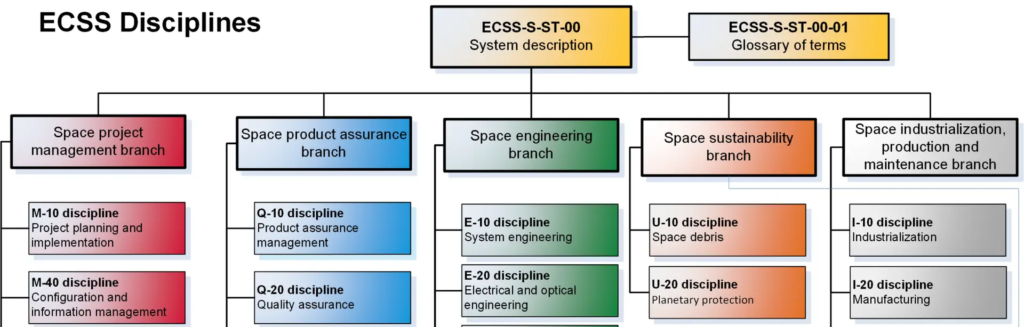
ECSS-E-ST-10 establishes the wider systems-engineering framework. ECSS-E-ST-10-02 addresses verification strategy, while ECSS-E-ST-10-03 governs verification through testing. These standards provide the framework, terminology and baseline philosophy. The actual test campaign must still be derived from the mission, hardware, model philosophy, customer requirements and applicable launch-provider documentation.
Engineers should care because applying a generic test profile without proper tailoring can create two opposing risks. Undertesting may leave important failure modes undiscovered. Overtesting may damage otherwise acceptable hardware, consume qualification margin or create results that do not represent the real mission environment.
The objective is therefore not simply to “test to ECSS”. The objective is to translate controlled programme requirements into a technically justified campaign that generates traceable and reviewable verification evidence.
What Is ECSS Environmental Testing?
Definition
ECSS environmental testing is the planned application of controlled environmental conditions to space products, models or flight hardware to demonstrate compliance with defined verification requirements.
Depending on the programme and model philosophy, testing may support qualification, acceptance, protoflight verification, workmanship screening, design development or investigation. The selected method, level, duration, tolerances, configuration and success criteria must be defined through the approved project documentation.
Purpose
The engineering purpose is to establish objective evidence that the product possesses the required design margin, workmanship integrity and functional performance for its intended mission.
Testing may also reveal:
-
Structural weaknesses.
-
Assembly or workmanship defects.
-
Inadequate interfaces or restraints.
-
Thermal-control limitations.
-
Functional failures under environmental exposure.
-
Unexpected resonances or dynamic responses.
-
Configuration or documentation weaknesses.
Where It Fits in a Space Programme
Design
Environmental requirements influence structural design, thermal design, component selection, interfaces and design margins.
Manufacturing
The as-built configuration must remain traceable to the verified design. Manufacturing changes can affect the validity of previous test evidence.
Assembly, Integration and Test
The AIT process controls hardware configuration, handling, instrumentation, functional checks and environmental-test sequencing.
Verification
Testing is one verification method alongside analysis, inspection, review of design and similarity. The chosen verification method must be appropriate to the requirement.
Flight Readiness
Successful testing alone does not establish flight readiness. Test results, anomalies, non-conformances, waivers, configuration records and verification status must be reviewed together before closure.
Why Is ECSS Environmental Testing Important?
Risk Reduction
A well-designed campaign identifies weaknesses before hardware reaches final integration or launch. Earlier detection generally provides more options for investigation, corrective action and controlled retesting.
However, testing does not remove all technical risk. Its value depends on the quality of the requirements, the representativeness of the configuration, the suitability of the test environment and the completeness of the evidence.
Compliance
ECSS establishes a controlled approach to verification rather than a stand-alone compliance label. Compliance is demonstrated through the approved requirements, tailoring decisions, verification planning, test documentation, results and formal closure records.
A laboratory should not claim that hardware is “ECSS certified” merely because an ECSS document informed the test. The customer or programme authority determines compliance against the applicable controlled baseline.
Verification Confidence
Verification confidence is built through:
-
Clear requirement allocation.
-
Defined pass and fail criteria.
-
Controlled hardware and software configuration.
-
Approved test methods and procedures.
-
Appropriate instrumentation.
-
Traceable calibration and data.
-
Recorded anomalies and deviations.
-
Technically complete test reports.
-
Formal review and acceptance of the evidence.
Mission Assurance
Environmental testing contributes to mission assurance by generating evidence that the hardware can tolerate the expected environment while remaining structurally sound and functionally capable.
It must still be combined with design analysis, manufacturing assurance, configuration control, quality management and programme review. Testing cannot compensate for unclear requirements or uncontrolled hardware changes.
How ECSS Applies to Environmental Testing
Relevant ECSS Standards
The precise standards depend on the product, mission and contractual baseline. Commonly relevant documents include:
| ECSS document | Typical role |
|---|---|
| ECSS-E-ST-10 | Overall systems-engineering framework and technical requirements structure. |
| ECSS-E-ST-10-02 | Verification concepts, strategy, implementation and verification documentation. |
| ECSS-E-ST-10-03 | On-ground testing requirements for space-segment elements and equipment. |
| ECSS-E-ST-10-04 | Natural and induced space environments and local environmental definition. |
| ECSS-E-ST-32 | Structural requirements relevant to mechanically induced loads and structural verification. |
| ECSS-E-HB-32-25 | Mechanical shock design and verification guidance. |
ECSS handbooks provide guidance and good practice. They do not automatically introduce additional contractual requirements.
Tailoring Considerations
ECSS requirements are intended to be tailored to the project. Tailoring should be controlled, technically justified and approved by the appropriate customer or programme authority.
Typical considerations include:
-
Mission duration and operational environment.
-
Launch vehicle and payload interface.
-
Hardware criticality.
-
Development maturity.
-
Model philosophy.
-
Qualification heritage.
-
Similarity evidence.
-
Available test margins.
-
Hardware limitations.
-
Cost and schedule constraints.
-
Customer and regulatory requirements.
Tailoring must not become an informal mechanism for deleting difficult requirements. Equally, applying every generic requirement without considering relevance can create cost, delay and unnecessary test severity.
Customer Requirements
Customer requirements may supplement, interpret or modify the ECSS baseline. Launcher interface requirements may also impose mission-specific environments, reporting formats, safety constraints or verification deliverables.
Where different sources apply, they should be reconciled into one controlled test specification. ECSS, NASA, GEVS and launch-provider documents are not interchangeable compliance routes.
The approved test specification should govern the campaign.
Typical Environmental Testing Process
Planning
Planning establishes:
-
The requirements to be verified.
-
The applicable standards and controlled revisions.
-
The model philosophy.
-
The test objectives.
-
The verification methods.
-
The hardware configuration.
-
The required facilities and instrumentation.
-
The proposed sequence.
-
The review and approval route.
Requirement conflicts, missing inputs and unresolved tailoring decisions should be addressed before detailed execution planning.
Preparation
Preparation normally includes:
-
Finalising the test specification and procedure.
-
Confirming the test article configuration.
-
Reviewing interfaces, fixtures and restraints.
-
Selecting instrumentation and control channels.
-
Confirming calibration status.
-
Defining functional checks.
-
Agreeing abort limits and safety controls.
-
Confirming data-acquisition requirements.
-
Closing Test Readiness Review actions.
Execution
Testing should follow the approved procedure and authorised changes. The test team should record the actual configuration, environmental conditions, responses, interruptions, deviations and anomalies.
If an unexpected response occurs, the priority should be protection of personnel, hardware and facility. Continuing merely to preserve schedule can undermine the test and damage the article.
Review
The review stage compares actual results with:
-
Test requirements.
-
Pass and fail criteria.
-
Control tolerances.
-
Response limits.
-
Functional expectations.
-
Pre-test predictions.
-
Recorded deviations and anomalies.
Unexpected results should be investigated rather than quietly normalised.
Closure
Closure requires more than completion of the test run. It normally includes:
-
Final data review.
-
Resolution of anomalies.
-
Non-conformance disposition.
-
Retest decisions where required.
-
Approved test reporting.
-
Verification record updates.
-
Customer acceptance of the evidence.
-
Configuration and documentation archiving.
Key Environmental Testing Activities
Vibration Testing
Vibration testing may include sine vibration, random vibration, resonance search, workmanship screening or other project-defined profiles.
Key activities can include:
-
Fixture design and assessment.
-
Test-article mounting.
-
Control and response accelerometer selection.
-
Low-level resonance surveys.
-
Notching or force-limiting strategy where justified.
-
Axis-by-axis test execution.
-
Functional checks before and after exposure.
-
Response review and comparison with predictions.
The test profile should reflect the approved programme and launcher requirements. A generic laboratory profile should not be substituted for a mission-derived specification without technical authority.
Mechanical Shock and SRS Testing
Shock testing may be used to represent separation or docking events, deployment mechanisms, pyrotechnic events or other short-duration transients.
Key activities can include:
-
Definition of the required shock response spectrum.
-
Assessment of source type and structural transmission path.
-
Selection of test method.
-
Fixture and boundary-condition review.
-
High-frequency instrumentation planning.
-
Control of overtest and undertest.
-
SRS calculation and tolerance review.
-
Investigation of abnormal structural or functional responses.
MIL-STD-810 shock procedures should not automatically be treated as equivalent to a launcher pyroshock requirement.
Thermal Vacuum Testing
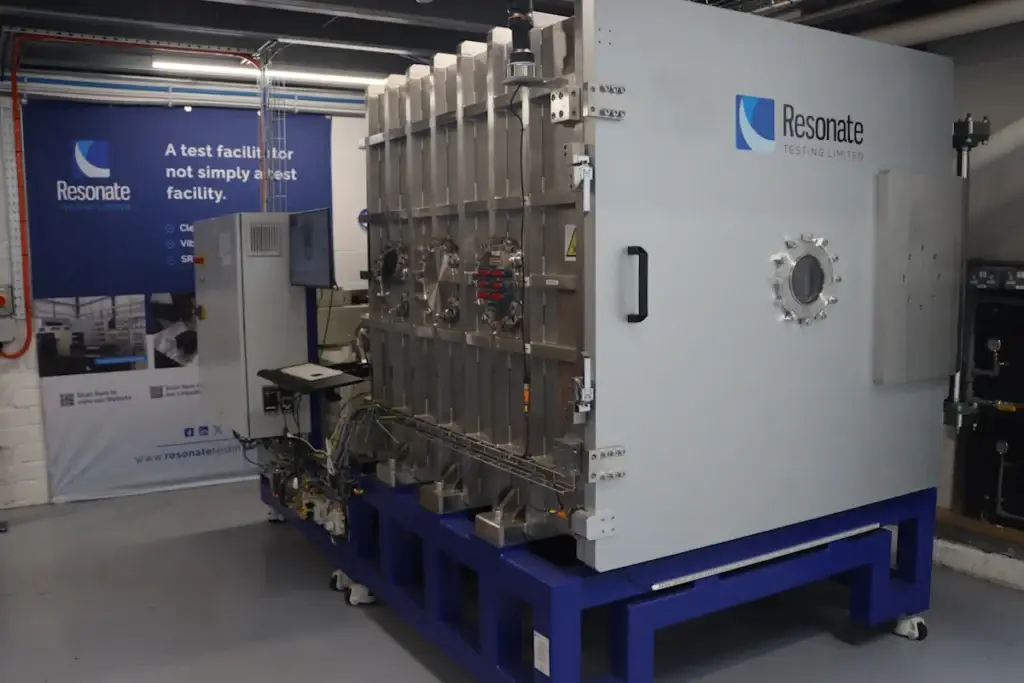
Thermal-vacuum testing assesses hardware under combined low-pressure and controlled thermal conditions. Depending on the programme, it may support qualification, acceptance, protoflight verification, thermal balance or functional demonstration.
Key activities can include:
-
Vacuum-chamber preparation.
-
Thermal sensor and control-point selection.
-
Temperature cycling.
-
Hot and cold dwell periods.
-
Functional operation during exposure.
-
Pressure and temperature monitoring.
-
Thermal stability assessment.
-
Pre-test and post-test inspections.
-
Controlled recovery to ambient conditions.
MIL-STD-810 low-pressure testing is not a substitute for spacecraft thermal-vacuum qualification.
Functional Monitoring
Functional monitoring should be planned around the verification objectives. It may include continuous monitoring, checks at thermal plateaux or defined checks before, during and after environmental exposure.
The test procedure should define:
-
Parameters to be monitored.
-
Acceptable ranges.
-
Data-recording rates.
-
Test hold criteria.
-
Abort criteria.
-
Anomaly escalation arrangements.
Common Risks and Challenges
Technical Risk
Poorly derived loads, unsuitable boundary conditions, inadequate instrumentation or unrepresentative fixtures can produce misleading results.
A successful test against the wrong requirement does not provide useful verification.
Schedule Risk
Late requirements, delayed procedures, unresolved interfaces and incomplete readiness actions can compress the test window. This can create pressure to proceed before the campaign is technically ready.
Cost Risk
Unnecessary test severity, repeated facility set-up, avoidable retesting and late hardware changes can increase cost rapidly.
Lowest initial test price does not necessarily produce the lowest campaign cost.
Verification Risk
Verification gaps can arise where:
-
Requirements are not allocated.
-
Pass criteria are unclear.
-
Results are not linked to requirements.
-
Tailoring is undocumented.
-
Analysis and test evidence conflict.
-
Anomalies remain unresolved.
-
Customer acceptance is assumed rather than recorded.
Documentation Risk
Incomplete or inconsistent documentation can weaken otherwise sound technical evidence. Common problems include uncontrolled document revisions, missing configuration records, undocumented deviations and reports that present data without a clear compliance conclusion.
Best Practices
Maintain Configuration Control
Record the exact test article, software version, build standard, mass properties, interfaces, fixture arrangement and instrumentation configuration.
If the configuration changes, assess whether existing evidence remains valid.
Ensure Requirement Traceability
Each test objective should link to a controlled requirement. The final report should show what was tested, the applicable criterion and the resulting status.
Use Suitable Test Equipment
Facilities, instrumentation and data systems should be technically appropriate for the required environment, frequency range, accuracy and hardware characteristics.
Where ISO/IEC 17025 accreditation is relevant, confirm that the activity is covered by the laboratory’s accredited scope. Accreditation should not be implied beyond that scope.
Conduct Independent Reviews
Independent technical review can expose assumptions, conflicting requirements, unrealistic profiles and weak success criteria before they affect the hardware.
Close Actions Before Progression
Readiness actions should be formally closed or consciously accepted by the authorised technical authority. Open actions should not disappear because the planned test date has arrived.
Test Like You Fly, Within Reason
The principle is valuable but must be applied intelligently. Exact replication may be impossible, unsafe or technically inappropriate. Differences between test and flight conditions should be identified, justified and supported by analysis where necessary.
Related Documentation
Verification Plan
Defines the overall verification strategy, methods, responsibilities, evidence and closure route.
AIT Plan
Describes the assembly, integration and test sequence, including configuration and handling controls.
Test Specification
Defines what must be demonstrated, the applicable requirements, test levels, durations, tolerances and acceptance criteria.
Test Procedure
Defines how the test will be executed, including set-up, instrumentation, sequencing, functional checks, holds and abort limits.
Test Report
Records the actual configuration, execution, results, deviations, anomalies and compliance conclusion.
Verification Control Document
Provides traceability between requirements, verification methods, evidence and closure status.
Non-Conformance Reports and Requests for Waiver
Record departures from requirements, unexpected results, investigation, technical disposition and formal approval.
How Success Is Measured
Requirement Compliance
The available evidence demonstrates that the defined requirement has been satisfied or that an approved deviation has been accepted.
Verification Closure
All relevant requirements have an agreed status supported by identifiable evidence.
Hardware Integrity
The test article remains structurally and functionally acceptable against the approved criteria.
Traceability
The relationship between requirement, test method, configuration, data, result and approval can be followed without relying on undocumented knowledge.
Flight Readiness
Environmental verification supports flight readiness when the evidence has been reviewed alongside outstanding risks, anomalies, non-conformances, waivers and configuration status.
Passing a laboratory test is an input to flight readiness. It is not flight approval by itself.
How Resonate Testing Supports ECSS Environmental Testing
Planning Support
Resonate Testing can help customers translate programme requirements into a practical test approach, identify missing information and define the evidence expected from the campaign.
Technical Guidance
We support technical discussions covering test method, configuration, instrumentation, sequencing, tolerances, functional monitoring and reporting.
The customer and designated programme authority retain responsibility for approving the requirements and compliance basis.
Test Campaign Development
Support can include the development of vibration, shock and thermal-vacuum campaigns based on customer-approved requirements.
Where several standards or launcher documents apply, the objective is to reconcile them into one controlled campaign rather than claim automatic equivalence.
Documentation Support
Support may include review or development of:
-
Test specifications.
-
Test procedures.
-
Readiness-review inputs.
-
Configuration records.
-
Test reports.
-
Verification evidence packs.
-
Requirement-to-evidence traceability.
Independent Review Support
An independent review can challenge unclear requirements, inconsistent levels, weak acceptance criteria and unsupported assumptions before testing begins.
Qualification and Flight Readiness Assistance
Resonate Testing can support qualification, acceptance and protoflight campaigns. Final qualification status, verification closure and flight readiness remain decisions for the customer and relevant programme authority.
Frequently Asked Questions
What is the difference between qualification and acceptance testing?
Qualification testing demonstrates design adequacy and margin. It is commonly conducted on dedicated qualification hardware or through an approved protoflight approach.
Acceptance testing is performed on flight hardware at less severe conditions to identify workmanship or material defects and confirm operational integrity.
What is protoflight testing?
Protoflight testing uses flight hardware and exposes it to qualification-type levels, typically with reduced duration or exposure compared with a full qualification campaign.
It can reduce the need for a dedicated qualification model, but it places greater importance on controlled test severity and hardware risk management.
Is environmental testing mandatory under ECSS?
The applicable verification requirements depend on the programme, product, contractual baseline and tailoring. ECSS provides the verification framework, but the approved programme documentation determines which activities are mandatory.
Can ECSS requirements be tailored?
Yes. Tailoring is a fundamental part of programme implementation. It should be technically justified, documented and approved. Tailoring is not the same as informal omission.
What evidence is required?
Evidence commonly includes approved specifications and procedures, readiness records, configuration data, calibration information, raw and processed test data, anomaly records, non-conformance dispositions and the final test report.
Can one test demonstrate compliance with ECSS, NASA, GEVS and a launch provider?
Not automatically. These documents serve different purposes and may use different assumptions, environments, margins and documentation requirements.
A campaign may address requirements derived from several sources, but the relationship must be demonstrated requirement by requirement.
Is MIL-STD-810 a spacecraft qualification standard?
No. MIL-STD-810 is a tailored environmental engineering and laboratory-method standard for materiel life cycles. Some methods may be relevant to transport, handling, defence or equipment-level requirements within a wider campaign.
It should not be described as universal spacecraft qualification.
Does a successful ECSS-informed test mean the hardware is ECSS certified?
No. ECSS does not provide a simple laboratory certification label for the tested hardware. Compliance depends on the programme requirements, approved tailoring, controlled evidence and acceptance by the appropriate technical authority.
Who defines the test profile?
The profile should be derived from the controlled project requirements, mission environment, launcher documentation, hardware characteristics and approved verification strategy.
The test laboratory should not independently substitute a generic profile for missing programme requirements.
What happens if the hardware exceeds a response limit?
The test procedure should define hold and abort criteria. The event should be recorded and reviewed before testing continues. Investigation may include data validation, fixture review, structural assessment, customer consultation and a formal non-conformance process.
Related Articles
Verification Philosophy
-
Qualification Testing Under ECSS
-
Acceptance Testing Under ECSS
-
Protoflight Testing
-
Model Philosophy
-
EQM vs PFM vs FM
Environmental Testing
-
Vibration Testing Under ECSS
-
Thermal Vacuum Testing Under ECSS
-
Mechanical Shock and SRS Testing
-
EMC Testing Under ECSS
-
Acoustic Testing Under ECSS
Programme and Verification
-
Verification Planning Under ECSS
-
Verification Matrices
-
Verification Evidence
-
Environmental Test Planning
-
The Space Qualification Process
Reviews and Documentation
-
Test Readiness Reviews
-
AIT Plans
-
Test Specifications
-
Test Procedures
-
Test Reports
-
Non-Conformances and Waivers
Discuss Your ECSS Environmental Test Programme
Environmental testing should begin with controlled requirements, not a convenient laboratory profile.
Resonate Testing can support the interpretation, planning and execution of customer-approved environmental test campaigns covering vibration, mechanical shock, SRS and thermal-vacuum testing.
Discuss your requirements with Resonate Testing.
Bring your applicable standards, verification requirements, launch-provider documentation and current test specification. We will help identify what applies, expose gaps and develop a technically controlled route to test evidence.
Your Test Facilitator. Not simply a test facility.