Explore our latest articles on testing methods, industry challenges and best practices, written by our engineering experts to help you make informed decisions.
BS 3G 100 can be understood as a structured set of engineering requirements intended to help answer one central question:
Will this aircraft equipment continue to function, or survive as required, when exposed to its intended operating environment?
Aircraft equipment can include:
Radios and communications units
Sensors
Electrical switches
Flight instruments
Display units
Control boxes
Electronic assemblies
Valves, pipes and fluid-system components
Depending on its location and function, this equipment may encounter:
Low temperatures during ground storage
High ground temperatures
Low pressure at altitude
Aircraft vibration
Moisture and condensation
Aviation fuels and lubricants
Hydraulic fluids
Cleaning and de-icing fluids
Fire exposure within designated fire zones
BS 3G 100 did not require every item to undergo every available test. The relevant equipment specification had to identify the applicable conditions, methods, severities, operating states and acceptance criteria.
That distinction remains important today.
A useful, though imperfect, analogy is a driving test.
A driving test does not prove that a person will perform perfectly throughout their entire life. It provides structured evidence that they can perform defined activities under controlled assessment conditions.
Environmental qualification follows similar logic.
Equipment is exposed to representative environmental conditions. Its operation, physical condition and performance are then assessed against agreed requirements.
A successful test provides evidence against the defined requirement. It does not, by itself, constitute aircraft certification or universal approval for every installation.
Approval decisions may also depend on:
The aircraft installation
The equipment design
The certification basis
Safety assessments
Configuration control
Additional qualification evidence
Acceptance by the appropriate authority
BS 3G 100 was a composite series. Individual subsections addressed different environmental and operational subjects.
This article concentrates on five examples.
| Subsection | Subject |
|---|---|
| BS 3G 100-2.3.0 | Standard environmental test requirements |
| BS 3G 100-2.3.1 | Vibration |
| BS 3G 100-2.3.2 | Temperature and pressure |
| BS 3G 100-2.3.12 | Fluid contamination |
| BS 3G 100-2.3.13 | Resistance to fire in designated fire zones |
| BS 3G 100-2.3.15 | Change of temperature |
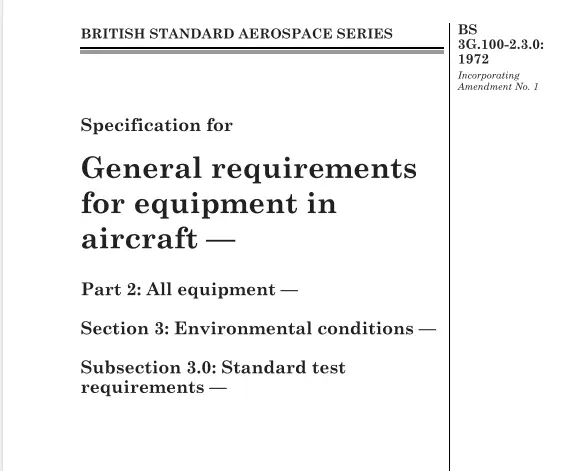
BS 3G 100-2.3.0 established common requirements used across the environmental subsections.
These included:
Standard atmospheric test conditions
Test-chamber performance
Temperature measurement
Temperature stabilisation
Representative equipment mounting
Representative supplies and services
Initial performance checks
Checks during or after environmental exposure
Recording deviations in the test report
The standard required equipment mounting to simulate the normal installation as closely as practicable. It also expected electrical power, air, hydraulics and other services to represent operational sources where possible.
This shows that BS 3G 100 was not concerned only with chamber settings. It also addressed configuration, installation and functional evidence.
Aircraft equipment can experience vibration from:
Engines and propulsion systems
Aerodynamic loading
Atmospheric turbulence
Ground operations
Aircraft structure
High external noise
Transonic or high-speed flight conditions
BS 3G 100-2.3.1 grouped equipment according to its location within the aircraft and linked vibration severity to flight conditions and anticipated exposure duration.
The standard described three broad test stages:
Initial resonance search
Vibration endurance
Final resonance search
The initial search identified resonances, malfunctions and performance changes. Endurance testing then assessed the equipment under the selected vibration environment. The final search helped identify changes in dynamic behaviour after exposure.
Wide-band random vibration was identified as the preferred endurance method because it was considered a better representation of the aircraft vibration environment. Alternative methods included narrow-band random vibration and sinusoidal testing.
The standard also recognised a point that remains essential today:
Vibration testing requires engineering judgement.
Aircraft equipment can experience very different environments depending on:
Aircraft type
Installed location
Ground climate
Altitude
Pressurisation
Solar heating
Equipment heat dissipation
Aircraft speed
BS 3G 100-2.3.2 classified aircraft and equipment so appropriate temperature and pressure requirements could be selected.
The available tests included:
Low-temperature ground survival
Low-temperature ground operation
Low-temperature flight operation
Temperature and humidity sequences
High-temperature ground survival
Short-term high-temperature operation
Long-term high-temperature operation
Low-altitude high-temperature flight
Intermediate-altitude operation
High-altitude operation
A survival test did not necessarily require the equipment to operate during exposure. An operational test assessed equipment performance under the stated environmental condition.
This distinction between survival and operation remains fundamental to environmental qualification.
Aircraft equipment can be exposed to fluids through normal operation, maintenance activity, accidental spillage or system leakage.
BS 3G 100-2.3.12 addressed fluid groups including:
Aviation fuels
Mineral and synthetic hydraulic fluids
Lubricating oils
Solvents
Cleaning fluids
De-icing and anti-freeze fluids
Runway de-icers
Insecticides
Coolant dielectric fluids
Fire extinguishants
The standard provided three broad exposure classes:
| Class | Exposure |
|---|---|
| A | Occasional contamination |
| B | Intermittent contamination |
| C | Extended contamination |
The selected fluid, exposure method, temperature, duration, operating condition and final examination had to be defined in the product specification.
The objective was to determine whether equipment, components, materials, joints, welds, bonds, seals, finishes or coatings would be unacceptably affected.
The standard did not claim to demonstrate continuous immersed operation. Nor was it an electrolytic corrosion test.
BS 3G 100-2.3.13 applied to components and equipment installed within designated aircraft fire zones.
It defined three grades:
| Grade | Minimum exposure requirement |
|---|---|
| Fire resistant | At least five minutes under the defined standard flame |
| Fireproof | At least fifteen minutes under the defined standard flame |
| Torching-flame resistant | At least two minutes under the defined torching flame |
The standard flame had a nominal temperature of 1,100°C. The equipment had to withstand the specified exposure without a malfunction that would jeopardise aircraft safety or aggravate an existing hazard.
The standard also addressed burner characteristics, calibration, mounting, operational conditions and test criteria.
Importantly, this subsection addressed resistance to fire in designated fire zones. It did not establish general aircraft-material flammability requirements.
BS 3G 100-2.3.15 addressed the effects of changing temperature on aircraft equipment.
It defined two categories:
Temperature variation
Thermal shock
Temperature variation represented gradual changes, such as those caused by aircraft climb and descent.
Thermal shock represented rapid changes that could produce:
Thermal stress
Fracture
Differential expansion
Seizure
Condensation
Changes in electrical performance
Changes in instrument accuracy
The 1978 British Standard was identical to ISO 2657:1976. This is useful evidence of increasing international alignment in aircraft environmental testing during that period.
BS 3G 100 helped establish a common engineering framework for aircraft equipment requirements.
It did more than name environmental tests. It connected the tests to:
Aircraft classifications
Equipment locations
Operational environments
Survival and operating states
Mounting arrangements
Functional checks
Product specifications
Defined acceptance evidence
It also recognised that standardised conditions must be selected and tailored to the equipment and installation.
The series therefore occupied a practical middle ground. It attempted to provide repeatable tests without pretending that every aircraft environment was identical.
Current programmes may use later standards, customer specifications or certification requirements. Nevertheless, BS 3G 100 remains relevant in several situations.
It may still appear in:
Legacy aircraft documentation
Existing equipment specifications
Long-running aviation programmes
Historical qualification records
Component replacement requirements
Comparative standards reviews
Fire, vibration and fluid-contamination research
Its engineering principles also remain familiar:
Define the intended environment.
Select relevant test conditions.
Reproduce those conditions under control.
Monitor equipment performance.
Record deviations and observations.
Compare results with defined acceptance criteria.
Use the resulting evidence within the wider qualification process.
That is a more accurate legacy than claiming that one standard created modern aerospace qualification.
Several misunderstandings should be avoided.
BS 3G 100 belonged to the Aerospace Series of British Standards. It was prepared and published through the British Standards framework.
The relevant equipment specification selected the applicable environmental requirements.
Testing generated evidence. Aircraft approval and certification depended on the wider design, installation and regulatory context.
Similar test names do not prove identical severity, duration, configuration or acceptance criteria. Any equivalence claim requires a controlled comparison.
BS 3G 100 was an important British framework for defining environmental requirements for aircraft equipment.
Its subsections addressed how equipment could be evaluated against vibration, temperature, pressure, moisture, fluid contamination, fire exposure and temperature change.
Its lasting lesson is straightforward:
Understand the intended environment, define the requirement and generate credible evidence before relying on equipment in service.
| Question | Answer |
|---|---|
| What is BS 3G 100? | A composite series of British Standards covering general requirements for equipment used in aircraft. |
| What did it address? | Environmental and operational requirements including vibration, temperature, pressure, fluids, fire and temperature change. |
| Did every test apply to every product? | No. Applicable requirements had to be selected in the relevant equipment specification. |
| Did passing a test certify the equipment? | No. Testing provided evidence within a wider approval or qualification process. |
| Why is it still relevant? | It appears in legacy programmes and illustrates principles that remain central to qualification engineering. |
| Who should understand it? | Engineers, students, test specialists, certification professionals and technical programme managers. |
BS 3G 100 was a British Standards framework for equipment used in aircraft. Its environmental subsections addressed vibration, temperature, pressure, moisture, fluid contamination, fire resistance and temperature change. The series helped engineers convert aircraft operating environments into controlled qualification requirements. Testing against those requirements generated evidence, but did not itself provide universal aircraft certification.

BS 3G 100 can be understood as a structured set of engineering requirements intended to help answer one central question:
Will this aircraft equipment continue to function, or survive as required, when exposed to its intended operating environment?
Aircraft equipment can include:
Radios and communications units
Sensors
Electrical switches
Flight instruments
Display units
Control boxes
Electronic assemblies
Valves, pipes and fluid-system components
Depending on its location and function, this equipment may encounter:
Low temperatures during ground storage
High ground temperatures
Low pressure at altitude
Aircraft vibration
Moisture and condensation
Aviation fuels and lubricants
Hydraulic fluids
Cleaning and de-icing fluids
Fire exposure within designated fire zones
BS 3G 100 did not require every item to undergo every available test. The relevant equipment specification had to identify the applicable conditions, methods, severities, operating states and acceptance criteria.
That distinction remains important today.
A useful, though imperfect, analogy is a driving test.
A driving test does not prove that a person will perform perfectly throughout their entire life. It provides structured evidence that they can perform defined activities under controlled assessment conditions.
Environmental qualification follows similar logic.
Equipment is exposed to representative environmental conditions. Its operation, physical condition and performance are then assessed against agreed requirements.
A successful test provides evidence against the defined requirement. It does not, by itself, constitute aircraft certification or universal approval for every installation.
Approval decisions may also depend on:
The aircraft installation
The equipment design
The certification basis
Safety assessments
Configuration control
Additional qualification evidence
Acceptance by the appropriate authority
BS 3G 100 was a composite series. Individual subsections addressed different environmental and operational subjects.
This article concentrates on five examples.
| Subsection | Subject |
|---|---|
| BS 3G 100-2.3.0 | Standard environmental test requirements |
| BS 3G 100-2.3.1 | Vibration |
| BS 3G 100-2.3.2 | Temperature and pressure |
| BS 3G 100-2.3.12 | Fluid contamination |
| BS 3G 100-2.3.13 | Resistance to fire in designated fire zones |
| BS 3G 100-2.3.15 | Change of temperature |
BS 3G 100-2.3.0 established common requirements used across the environmental subsections.
These included:
Standard atmospheric test conditions
Test-chamber performance
Temperature measurement
Temperature stabilisation
Representative equipment mounting
Representative supplies and services
Initial performance checks
Checks during or after environmental exposure
Recording deviations in the test report
The standard required equipment mounting to simulate the normal installation as closely as practicable. It also expected electrical power, air, hydraulics and other services to represent operational sources where possible.
This shows that BS 3G 100 was not concerned only with chamber settings. It also addressed configuration, installation and functional evidence.
Aircraft equipment can experience vibration from:
Engines and propulsion systems
Aerodynamic loading
Atmospheric turbulence
Ground operations
Aircraft structure
High external noise
Transonic or high-speed flight conditions
BS 3G 100-2.3.1 grouped equipment according to its location within the aircraft and linked vibration severity to flight conditions and anticipated exposure duration.
The standard described three broad test stages:
Initial resonance search
Vibration endurance
Final resonance search
The initial search identified resonances, malfunctions and performance changes. Endurance testing then assessed the equipment under the selected vibration environment. The final search helped identify changes in dynamic behaviour after exposure.
Wide-band random vibration was identified as the preferred endurance method because it was considered a better representation of the aircraft vibration environment. Alternative methods included narrow-band random vibration and sinusoidal testing.
The standard also recognised a point that remains essential today:
Vibration testing requires engineering judgement.
Aircraft equipment can experience very different environments depending on:
Aircraft type
Installed location
Ground climate
Altitude
Pressurisation
Solar heating
Equipment heat dissipation
Aircraft speed
BS 3G 100-2.3.2 classified aircraft and equipment so appropriate temperature and pressure requirements could be selected.
The available tests included:
Low-temperature ground survival
Low-temperature ground operation
Low-temperature flight operation
Temperature and humidity sequences
High-temperature ground survival
Short-term high-temperature operation
Long-term high-temperature operation
Low-altitude high-temperature flight
Intermediate-altitude operation
High-altitude operation
A survival test did not necessarily require the equipment to operate during exposure. An operational test assessed equipment performance under the stated environmental condition.
This distinction between survival and operation remains fundamental to environmental qualification.
Aircraft equipment can be exposed to fluids through normal operation, maintenance activity, accidental spillage or system leakage.
BS 3G 100-2.3.12 addressed fluid groups including:
Aviation fuels
Mineral and synthetic hydraulic fluids
Lubricating oils
Solvents
Cleaning fluids
De-icing and anti-freeze fluids
Runway de-icers
Insecticides
Coolant dielectric fluids
Fire extinguishants
The standard provided three broad exposure classes:
| Class | Exposure |
|---|---|
| A | Occasional contamination |
| B | Intermittent contamination |
| C | Extended contamination |
The selected fluid, exposure method, temperature, duration, operating condition and final examination had to be defined in the product specification.
The objective was to determine whether equipment, components, materials, joints, welds, bonds, seals, finishes or coatings would be unacceptably affected.
The standard did not claim to demonstrate continuous immersed operation. Nor was it an electrolytic corrosion test.
BS 3G 100-2.3.13 applied to components and equipment installed within designated aircraft fire zones.
It defined three grades:
| Grade | Minimum exposure requirement |
|---|---|
| Fire resistant | At least five minutes under the defined standard flame |
| Fireproof | At least fifteen minutes under the defined standard flame |
| Torching-flame resistant | At least two minutes under the defined torching flame |
The standard flame had a nominal temperature of 1,100°C. The equipment had to withstand the specified exposure without a malfunction that would jeopardise aircraft safety or aggravate an existing hazard.
The standard also addressed burner characteristics, calibration, mounting, operational conditions and test criteria.
Importantly, this subsection addressed resistance to fire in designated fire zones. It did not establish general aircraft-material flammability requirements.
BS 3G 100-2.3.15 addressed the effects of changing temperature on aircraft equipment.
It defined two categories:
Temperature variation
Thermal shock
Temperature variation represented gradual changes, such as those caused by aircraft climb and descent.
Thermal shock represented rapid changes that could produce:
Thermal stress
Fracture
Differential expansion
Seizure
Condensation
Changes in electrical performance
Changes in instrument accuracy
The 1978 British Standard was identical to ISO 2657:1976. This is useful evidence of increasing international alignment in aircraft environmental testing during that period.
BS 3G 100 helped establish a common engineering framework for aircraft equipment requirements.
It did more than name environmental tests. It connected the tests to:
Aircraft classifications
Equipment locations
Operational environments
Survival and operating states
Mounting arrangements
Functional checks
Product specifications
Defined acceptance evidence
It also recognised that standardised conditions must be selected and tailored to the equipment and installation.
The series therefore occupied a practical middle ground. It attempted to provide repeatable tests without pretending that every aircraft environment was identical.
Current programmes may use later standards, customer specifications or certification requirements. Nevertheless, BS 3G 100 remains relevant in several situations.
It may still appear in:
Legacy aircraft documentation
Existing equipment specifications
Long-running aviation programmes
Historical qualification records
Component replacement requirements
Comparative standards reviews
Fire, vibration and fluid-contamination research
Its engineering principles also remain familiar:
Define the intended environment.
Select relevant test conditions.
Reproduce those conditions under control.
Monitor equipment performance.
Record deviations and observations.
Compare results with defined acceptance criteria.
Use the resulting evidence within the wider qualification process.
That is a more accurate legacy than claiming that one standard created modern aerospace qualification.
Several misunderstandings should be avoided.
BS 3G 100 belonged to the Aerospace Series of British Standards. It was prepared and published through the British Standards framework.
The relevant equipment specification selected the applicable environmental requirements.
Testing generated evidence. Aircraft approval and certification depended on the wider design, installation and regulatory context.
Similar test names do not prove identical severity, duration, configuration or acceptance criteria. Any equivalence claim requires a controlled comparison.
BS 3G 100 was an important British framework for defining environmental requirements for aircraft equipment.
Its subsections addressed how equipment could be evaluated against vibration, temperature, pressure, moisture, fluid contamination, fire exposure and temperature change.
Its lasting lesson is straightforward:
Understand the intended environment, define the requirement and generate credible evidence before relying on equipment in service.
| Question | Answer |
|---|---|
| What is BS 3G 100? | A composite series of British Standards covering general requirements for equipment used in aircraft. |
| What did it address? | Environmental and operational requirements including vibration, temperature, pressure, fluids, fire and temperature change. |
| Did every test apply to every product? | No. Applicable requirements had to be selected in the relevant equipment specification. |
| Did passing a test certify the equipment? | No. Testing provided evidence within a wider approval or qualification process. |
| Why is it still relevant? | It appears in legacy programmes and illustrates principles that remain central to qualification engineering. |
| Who should understand it? | Engineers, students, test specialists, certification professionals and technical programme managers. |
BS 3G 100 was a British Standards framework for equipment used in aircraft. Its environmental subsections addressed vibration, temperature, pressure, moisture, fluid contamination, fire resistance and temperature change. The series helped engineers convert aircraft operating environments into controlled qualification requirements. Testing against those requirements generated evidence, but did not itself provide universal aircraft certification.
Whether you’re looking to contact us for the first time or have another testing requirement, we’d love to hear from you.