
© 2026 ResonateTesting Ltd.
Understand how ADR Special Provision 376 applies to damaged or defective lithium and sodium-ion batteries, including assessment, classification, packaging and the appropriate route for safe onward transport.
ADR, the Agreement concerning the International Carriage of Dangerous Goods by Road, includes Special Provision 376 (SP 376), which applies to lithium-metal, lithium-ion and sodium-ion cells and batteries identified as damaged or defective, including batteries that cannot be diagnosed before carriage.
A safety-related defect may bring a battery within SP 376 even when obvious external damage is not present.
Examples of conditions requiring assessment can include:
Leakage or venting.
Physical damage.
Deformation or swelling.
Abnormal terminal or insulation behaviour.
Damage to the battery management system or other safety devices.
Thermal runaway, rupture or disassembly.
An abnormal or uncertain post-test condition.
One of the most important considerations when dealing with a battery following testing is that a failed test criterion does not automatically determine the packing instruction.
UN 38.3 establishes the test status of a battery design type. It is not itself a packaging instruction. Following a test failure, the resulting condition of the individual battery must therefore be assessed.
The assessment should consider the battery’s:
Physical condition.
Thermal condition.
Electrical condition.
Evidence of leakage or venting.
Deformation or swelling.
Terminal and insulation condition.
Battery management system and safety devices.
A planned abuse or safety test does not itself make the battery damaged or defective. The post-test condition is what must be assessed. Where that condition has not been established, the battery should remain quarantined pending assessment against manufacturer safety criteria or by a qualified technical expert.
The assessment should be based on safety criteria from the cell, battery or product manufacturer, or be carried out by a technical expert with knowledge of the cell or battery’s safety features.
Determine whether the individual battery remains representative of its successfully tested UN 38.3 design type and is safe for normal transport.
Determine whether the battery is damaged, defective for safety reasons or cannot be diagnosed before carriage.
The assessment then considers whether the battery is liable during normal carriage to:
Rapidly disassemble.
Dangerously react.
Produce a flame.
Produce dangerous heat.
Emit toxic, corrosive or flammable gases or vapours.
Where SP 376 applies, the outcome of the risk assessment determines whether P908/LP904 or P911/LP906 applies.
The packing route depends on the assessed condition of the battery rather than simply whether the battery has failed a test.
| Battery condition | Carriage provision | Packing route |
|---|---|---|
| Safe, undamaged and remains representative of its UN 38.3 tested design type | Normal applicable UN entry | Applicable normal packing instruction |
| Damaged or defective, with higher-risk behaviour not identified | ADR SP 376 | P908 or LP904 |
| Damaged or defective and liable to dangerous reaction, rapid disassembly, flame, dangerous heat or hazardous gas | ADR SP 376 | P911 or LP906 |
| Severe behaviour cannot be credibly excluded | Quarantine pending assessment | Escalate rather than defaulting to P908/LP904 |
This distinction is particularly important because P908/LP904 should not simply become the default option whenever a battery is considered damaged.
P908 and LP904 apply to damaged or defective batteries where the specified higher-risk behaviour under SP 376 has not been identified through assessment. P908 applies to packages, while LP904 provides the corresponding large-packaging route.
P911 or LP906 applies to the higher-risk SP 376 route, where a damaged or defective battery is liable, under normal conditions of carriage, to:
Rapidly disassemble.
Dangerously react.
Produce a flame.
Produce dangerous heat.
Emit toxic, corrosive or flammable gases or vapours.
P911 applies to packages, while LP906 applies to large packaging. Batteries following this route must use an applicable performance-verified configuration.
Where a battery cannot be properly diagnosed before carriage, or where its condition remains uncertain, it should remain quarantined pending further assessment.
An uncertain battery condition should not automatically result in the selection of P908 or LP904. The appropriate packing route should only be selected once the battery’s condition and potential behaviour have been assessed
P908 permits specified drums, boxes and jerricans that meet the Packing Group II performance level.
The packaging requirements include:
Each damaged or defective battery, cell or item of equipment must be individually packed in an inner packaging and placed inside an outer packaging.
Either the inner or outer packaging must be leak-proof to prevent potential electrolyte release.
The inner packaging must be surrounded by sufficient non-combustible and electrically non-conductive thermal insulation material.
Sealed packaging must incorporate an appropriate means of venting where required.
Measures must minimise the effects of vibration and shock and prevent movement that could cause further damage or create a dangerous condition.
Any cushioning used for this purpose must meet the applicable non-combustibility and electrical-conductivity requirements.
Where a battery is leaking, sufficient inert absorbent material must be included to absorb released electrolyte.
Cells and batteries must be protected against short circuit.
A cell or battery with a net mass greater than 30 kg is limited to one cell or battery per outer packaging.
Permitted rigid large packagings include steel (50A), aluminium (50B), other metal (50N), rigid plastics (50H) and plywood (50D). These must meet the Packing Group II performance level.
LP904 requires:
Individual inner packaging within the large outer packaging.
Leak-proof inner or outer packaging to prevent electrolyte release.
Sufficient non-combustible and electrically non-conductive thermal insulation.
Appropriate venting for sealed packaging where required.
Protection against vibration, shock and movement that could result in further damage.
Suitable non-combustible and electrically non-conductive cushioning where used for this purpose.
Sufficient inert absorbent material where electrolyte leakage may occur.
Protection against short circuits.
The key difference between P908 and LP904 is therefore the packaging format. P908 covers conventional packages, while LP904 provides the corresponding large-packaging solution and is limited to a single damaged/defective battery or single item of equipment.
Unlike P908, P911 packaging must meet the Packing Group I performance level and satisfy additional performance requirements for a severe battery event.
The completed package must be capable of ensuring that:
Its external surface temperature does not exceed 100°C, although a momentary spike up to 200°C is acceptable.
No flame occurs outside the package.
No projectiles leave the package.
The structural integrity of the package is maintained.
An appropriate gas-management system is provided, which may involve filtration, air circulation, gas containment or gas-tight packaging depending on the arrangement.
Rigid large packagings must meet the Packing Group I performance level, with permitted materials including steel (50A), aluminium (50B), other metal (50N), rigid plastics (50H), wood (50D) and rigid fibreboard (50G).
Like P911, the large packaging must satisfy additional performance requirements during a severe battery event:
External surface temperature must not exceed 100°C, apart from an acceptable momentary spike up to 200°C.
No flame may occur outside the packaging.
No projectiles may leave the packaging.
Structural integrity must be maintained.
An appropriate gas-management system must be provided.
These performance requirements must be verified by testing specified by the competent authority. The verification report identifies important limits of the arrangement, including the battery type, maximum number of batteries, total battery mass, total energy content, large-packaging identification and test data. Specific instructions describing how the packaging is to be used must also accompany the verification information.
The distinction between conventional and large packaging applies to both SP 376 routes. P908 and LP904 apply where the specified severe behaviour has not been identified, while P911 and LP906 apply to batteries liable to exhibit the severe behaviours specified by SP 376. Within these routes, P908 and P911 use conventional packages, while LP904 and LP906 provide the corresponding large-packaging options. The appropriate selection depends on the battery and applicable packaging configuration rather than battery mass alone.
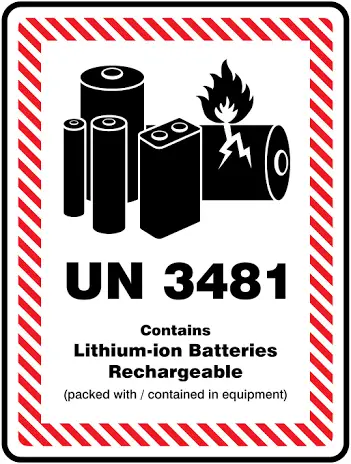
Once SP 376 classification has been confirmed, the applicable markings, labels and documentation must be established.
The applicable UN number should be determined based on the battery chemistry and transport classification.
Damaged or Defective Battery Marking:
The package wording should correspond with the battery chemistry:
DAMAGED/DEFECTIVE LITHIUM ION BATTERIES
DAMAGED/DEFECTIVE LITHIUM METAL BATTERIES
DAMAGED/DEFECTIVE SODIUM ION BATTERIES
The damaged/defective wording is separate from the applicable UN number and hazard labelling.
The applicable UN number, hazard labels and other required ADR markings must be verified for the individual shipment before release. The exact requirements depend on the battery classification and shipment configuration.

Correct documentation is an important part of transporting a damaged or defective battery.
Once SP 376 applies, the transport documentation should describe the batteries as they are packed for transport, rather than simply describing them as test samples or by their original design status.
Relevant information includes:
Battery chemistry.
Applicable UN number.
Proper shipping name.
ADR particulars.
Packing instruction or applicable approval evidence.
Applicable SP 376 carriage statement.
The transport documentation must include the applicable SP 376 carriage statement.
Where a competent-authority approval or alternative arrangement is used, the relevant documentation should accompany the shipment. Otherwise, the selected packing instruction and approved as-packed configuration should be verified before release.
Correct classification and packaging are only part of the release process.
Before the battery is released, the following should be confirmed:
Battery classification
Applicable packaging
The as-packed configuration
ADR marking and labelling
Transport documentation
Dangerous-goods sign-off
Carrier acceptance for the exact configuration
For batteries undergoing testing at Resonate, SP 376 becomes particularly relevant where testing results in damage, abnormal behaviour or an uncertain post-test condition.
Resonate Testing can provide technical evidence from the testing process and the resulting condition of the test item to support subsequent transport assessment. This provides a documented link between what occurred during testing, the battery’s post-test condition and the information required when determining its appropriate handling and onward transport.
Contact Resonate Testing Ltd to discuss your battery testing requirements and the technical information available following testing.
Use the contact route to share the requirement, test profile, drawings or specification for review.
Whether you’re looking to contact us for the first time or have another testing requirement, we’d love to hear from you.