UKAS-accredited SAE AS1055 fire testing for aerospace hose, tube and fitting assemblies, evaluating fire resistance under representative pressure, flow, airflow and vibration conditions.
Accredited
Scope Available
Programmes
Plus Certified
Expertise
Test Evidence
SAE AS1055 is an aerospace product-test standard for complete, pressure-containing fluid-system assemblies used in aircraft powerplant installations. It applies to flexible hoses, rigid tube assemblies, coils, fittings and similar components—not simply to individual materials.
Resonate provides SAE AS1055 fire testing for flexible hoses, rigid tubes, coils, fittings and similar aerospace fluid-system assemblies. Each programme is built around the controlled requirement and representative hardware, with burner calibration, pressure, fluid circulation, airflow, vibration and instrumentation included where the approved test configuration requires them.

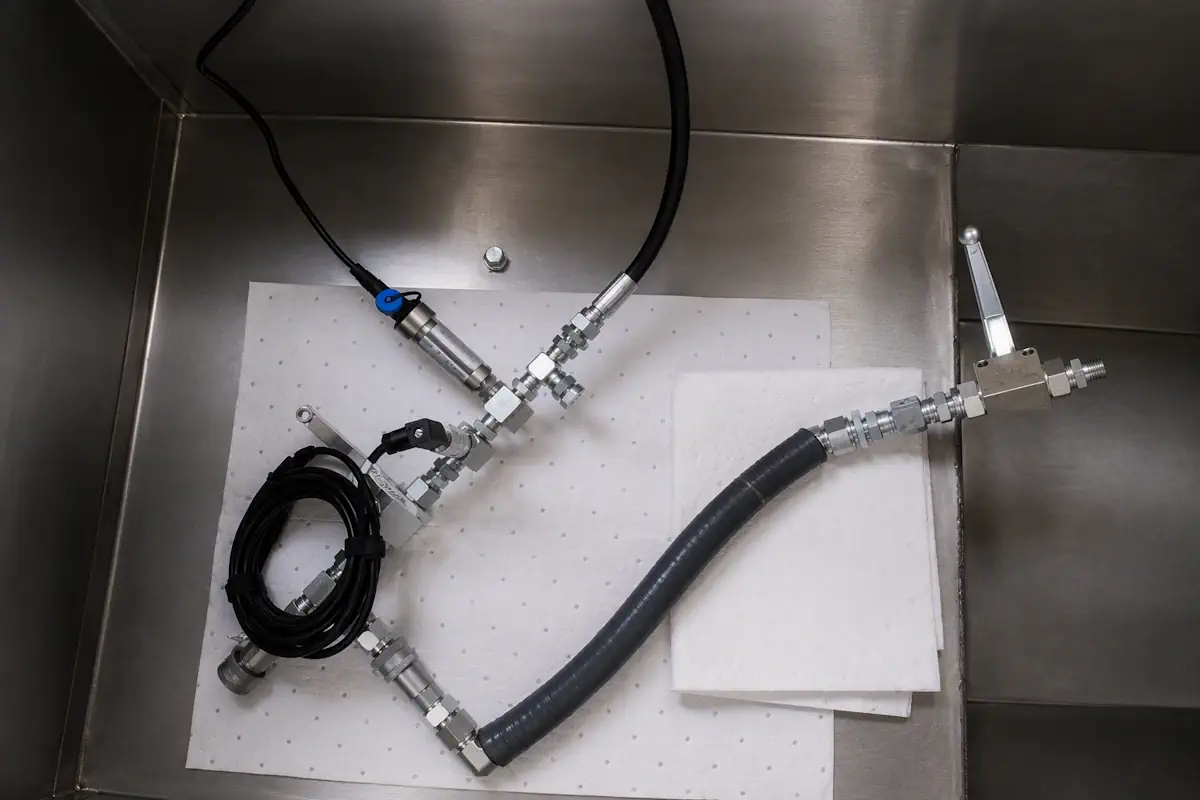

Early review confirms the applicable AS1055 revision, Class A or Class B requirement, production configuration and acceptance criteria before fixtures are committed.
Share the assembly drawings, hose or tube construction, fittings, seals, firesleeve details, operating fluid conditions, pressure, flow, vibration and reporting needs.
AS1055 is the product-test standard. SAE AIR1377 addresses test equipment and calibration, while FAA Engineering Report No. 3A provides the historical apparatus, airflow, vibration and fluid-circulation framework.
These references are complementary rather than interchangeable. The controlled test plan should identify the exact standard revision, certification basis, classification and any customer-specific procedure before testing begins.
The applicable regulation, installation hazard and certification basis determine the required classification—not the laboratory.
The test evaluates the complete fluid-conveyance assembly under severe flame exposure and representative operating conditions. Assessment can include rupture, separation, prohibited leakage or spray, pressure or flow loss, seal extrusion, fitting loosening, firesleeve displacement and loss of required function.
Acceptance criteria must be explicit before the test. “Survived the fire” is not sufficient: the plan should define allowable leakage, required function, inspection points and pass/fail evidence.
Resonate’s specialist fire laboratory uses a remotely controlled, carriage-mounted kerosene burner. Separate areas support burner warm-up, heat-transfer calibration, flame-temperature calibration and specimen testing, while adjustable burner orientation supports horizontal and vertical configurations.
Measurements can include flame and component temperature, heat transfer, pressure, flow, leakage, vibration and functional performance. Multiple-angle video and real-time data display can support test witnessing and the final evidence package.
Resonate Testing is UKAS accredited to ISO/IEC 17025:2017 under Schedule 9373. The schedule covers aircraft powerplant components and identifies SAE AS1055, SAE AIR/AS1377 and FAA Engineering Report No. 3A within the relevant scope. Accreditation for the exact requested configuration is confirmed during technical review.
| Specification | Capability |
|---|---|
| Test type | SAE AS1055 fire testing of fluid-system assemblies |
| Nominal flame temperature | Near 1,093°C / 2,000°F; exact tolerance depends on the applicable revision and approved procedure |
| Classifications | Class A fire resistant: five minutes; Class B fireproof: 15 minutes |
| Component types | Flexible hoses, rigid tubes, coils, fittings, joints, seals and firesleeves |
| Combined conditions | Working pressure, fluid circulation, controlled airflow and vibration where required |
| Instrumentation | Temperature rake, calorimeter, pressure, flow, leakage, vibration, function and video |
| Assessment focus | Rupture, separation, leakage, spray, pressure or flow loss and required function |
| Planning support | Revision review, fixture design, safety review, instrumentation and reporting scope |
| Term | Meaning in an AS1055 programme |
|---|---|
| Fire resistant (Class A) | The historical AS1055 classification requiring no disqualifying rupture or leakage before five minutes, subject to the applicable revision and approved acceptance criteria. |
| Fireproof (Class B) | The historical AS1055 classification requiring no disqualifying rupture or leakage before 15 minutes, subject to the applicable revision and approved acceptance criteria. |
| Representative assembly | A test article that reflects the intended production configuration, including hose or tube construction, fittings, joints, seals, firesleeves, mounting and orientation. |
| Controlled test plan | The approved document defining the standard revision, configuration, operating conditions, exposure, instrumentation, acceptance criteria and reporting requirements. |
| Flame calibration | Verification that the burner achieves the specified flame-temperature condition before specimen exposure. |
| Heat-transfer calibration | Verification that the burner delivers the required thermal energy to the defined calibration device or method. |
| Working pressure | The agreed internal pressure applied to the assembly during exposure to represent the required operating condition. |
| Fluid circulation | Controlled movement of the specified test fluid through the assembly during exposure, where required by the programme. |
| Disqualifying leakage | Leakage that exceeds the agreed pass/fail limit. The test plan should distinguish seepage, droplets, continuous leakage, spray, rupture and ignited leakage. |
| Deviation | Any departure from the approved procedure, configuration or target condition that must be recorded and assessed in the test report. |
The controlled test plan should distinguish seepage, droplets, continuous leakage, spray, rupture and ignited leakage. Inspection can also cover separation, seal extrusion, fitting loosening, firesleeve displacement, pressure or flow loss and any loss of required function.
Risks associated with pressurised fluids, stored energy and combustible media should be reviewed before the setup is fixed. Instrumentation, photographs, witness points, post-test inspection and safe depressurisation steps should also be agreed in advance.
AS1055 assemblies may need representative working pressure, fluid circulation, airflow and vibration during flame exposure. Coordinating these conditions helps reproduce installation loads and reveal failures that a static exposure may not show.
For projects that also need mechanical or environmental testing, review the related services before finalising the campaign sequence and evidence package.
Use the contact route to share the requirement, test profile, drawings or specification for review.
Whether you’re looking to contact us for the first time or have another testing requirement, we’d love to hear from you.