
© 2026 ResonateTesting Ltd.
Accredited
Scope Available
Programmes
Plus Certified
Expertise
Test Evidence
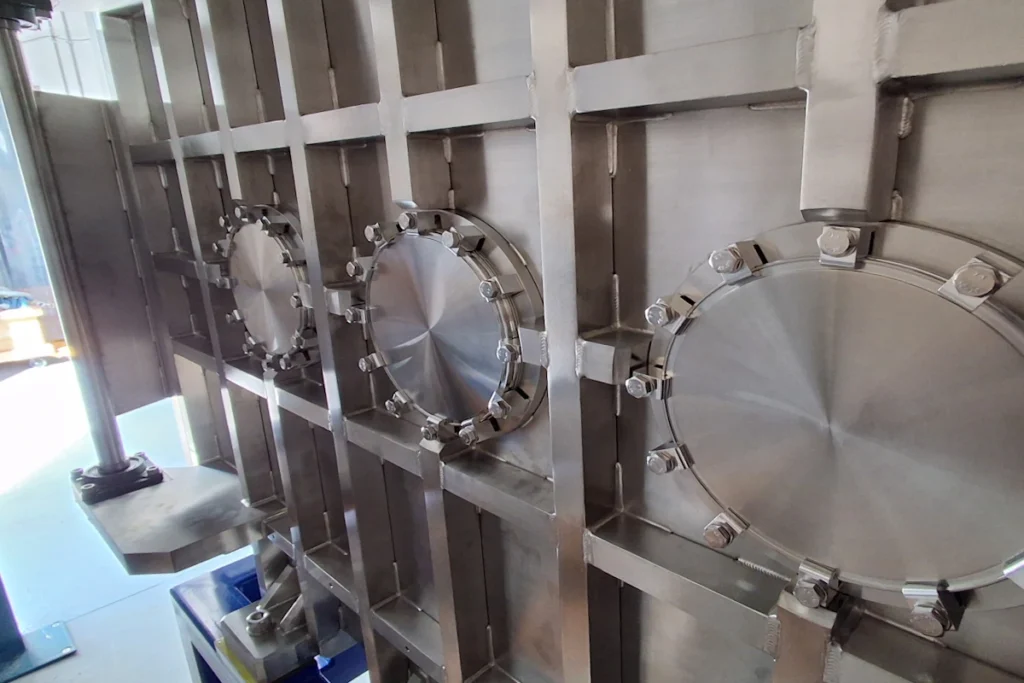
Thermal Vacuum Testing, commonly called TVAC, exposes space hardware to controlled vacuum and temperature conditions. It provides evidence that equipment, subsystems, payloads or complete space-segment elements can survive and operate under defined mission-relevant environments.
TVAC matters because hardware behaves differently when atmospheric pressure and convective cooling are removed. Heat moves primarily through conduction and radiation. Electronic components, thermal interfaces, materials, lubricants, connectors and mechanisms can therefore behave differently from their performance under ambient laboratory conditions.
Within an ECSS verification programme, TVAC may support development, qualification, acceptance or protoflight objectives. The selected temperatures, vacuum conditions, cycle count, dwell periods, operating modes and functional checks depend on the product level, model philosophy, mission environment and approved project requirements.
The purpose is not simply to reach a low pressure and cycle between hot and cold temperatures. The purpose is to generate controlled evidence against specific requirements.
For engineering and AIT teams, TVAC is a valuable opportunity to identify thermal, functional, workmanship and contamination-related problems before delivery or launch.
✓ Environmental Test Expertise
✓ Space Industry Experience
✓ ECSS-Aligned Verification Support
✓ Independent Technical Guidance
✓ Qualification and Verification Focus
Each trust statement should link to controlled evidence before external publication.
Thermal Vacuum Testing is the controlled exposure of a test article to vacuum and specified temperature conditions.
Depending on the verification objective, the campaign may include:
high and low temperature exposure;
repeated thermal cycles;
controlled transitions;
thermal plateaux;
hot and cold dwell periods;
powered operation;
functional checks;
performance measurements;
mechanism operation;
switch-on checks;
survival exposure; and
contamination monitoring where required.
TVAC is used to assess whether the test article performs according to its specification under the agreed environmental conditions.
The engineering purpose is to investigate or demonstrate:
operation without atmospheric pressure;
performance without convective cooling;
thermal-control effectiveness;
survival at specified extremes;
operation at hot and cold limits;
behaviour through thermal expansion and contraction;
electrical and mechanical interface stability;
workmanship integrity;
vacuum compatibility; and
continued functional performance after exposure.
TVAC does not reproduce every feature of the space environment. Radiation, atomic oxygen, plasma, debris and launch loads require separate consideration.
Conventional environmental chambers normally use air to transfer heat.
In vacuum, convection is effectively removed. Heat transfer occurs mainly through:
conduction through the fixture, interfaces and cables;
radiation between the test article and chamber shroud; and
internally generated heat from powered hardware.
A test article may therefore reach different component temperatures in vacuum than it reaches at the same chamber set point in air.
Thermal vacuum testing and thermal balance testing should not be treated as synonyms.
Thermal vacuum testing assesses performance or survival under vacuum and specified thermal conditions.
Thermal balance testing is normally used to correlate and adjust the thermal mathematical model and verify the thermal design under controlled steady-state conditions.
A campaign may include both objectives, but the specification, configuration and evidence requirements should identify them separately.
The programme identifies the applicable mission and product environments.
Inputs may include:
mission orbit;
operational modes;
eclipse and sunlight conditions;
launcher interfaces;
thermal analysis;
survival requirements;
operating limits;
switch-on limits;
customer requirements; and
contamination constraints.
A mission environment is not automatically a laboratory profile. It must be translated into controlled test conditions.
Thermal design establishes the intended heat paths and controls.
Relevant features can include:
conductive interfaces;
thermal straps;
coatings;
radiators;
insulation;
heaters;
thermostats;
sensors;
thermal-control software; and
operational constraints.
TVAC results can be used to assess whether these provisions behave as expected.
Manufacturing and assembly can introduce defects that remain hidden at ambient conditions.
Thermal cycling can expose issues involving:
solder joints;
connectors;
fasteners;
adhesives;
bonding;
harnesses;
seals;
coatings;
mechanisms; and
material compatibility.
TVAC forms part of the wider AIT programme.
It may be sequenced with:
vibration testing;
acoustic testing;
shock testing;
EMC verification;
leak testing;
alignment checks;
functional testing; and
performance testing.
Sequence matters. The project should know which environmental exposure occurred before an anomaly was detected.
The resulting evidence is assessed against the applicable requirements.
The customer or appointed verification authority determines whether the evidence supports requirement closure.
Successful TVAC contributes to the overall flight-readiness evidence.
It does not independently approve the product for flight. Flight readiness also depends on other verification, product assurance, configuration, safety and programme evidence.
TVAC can reveal problems that are not evident during ambient testing.
Examples include:
local overheating;
inadequate conductive paths;
unexpected thermal gradients;
cold-sensitive electronics;
hot or cold start-up failures;
connector intermittency;
mechanism performance changes;
lubrication problems;
material outgassing;
thermal-control instability; and
software responses to temperature.
Early discovery allows corrective action before the hardware becomes inaccessible or is committed to launch.
A controlled TVAC campaign generates evidence about the article’s behaviour under defined environmental conditions.
Confidence depends on more than the chamber profile. It also depends on:
representative configuration;
suitable instrumentation;
controlled interfaces;
calibrated equipment;
measurement uncertainty;
agreed operating modes;
functional checks;
clear success criteria;
anomaly control; and
traceable reporting.
Repeated thermal transitions can stress materials and interfaces.
Expansion and contraction may reveal intermittent or latent defects that remain hidden at room temperature.
This is particularly relevant during acceptance and protoflight campaigns.
TVAC can help assess whether the hardware can manage internally generated and externally imposed thermal conditions.
The test can support evaluation of:
heater performance;
thermostat operation;
sensor behaviour;
thermal interfaces;
conductive paths;
radiative surfaces;
insulation; and
thermal-control algorithms.
TVAC reduces the risk of discovering thermal or vacuum-related problems after launch.
It cannot guarantee mission success. It is one part of a wider verification strategy.
ECSS-E-ST-10 provides the wider system-engineering framework.
It connects thermal verification with:
system requirements;
design;
interfaces;
technical risk;
model philosophy;
verification planning; and
engineering reviews.
ECSS-E-ST-10-02 addresses verification.
It defines how requirements are connected to:
verification methods;
verification levels;
verification stages;
models;
conditions;
evidence; and
requirement close-out.
TVAC is a verification method only where the test can produce suitable evidence against the requirement.
ECSS-E-ST-10-03C Rev.1 is the principal general ECSS testing standard.
It addresses:
qualification testing;
acceptance testing;
protoflight testing;
thermal vacuum testing;
thermal cycling;
functional and performance testing;
test conditions;
tolerances;
measurement uncertainty;
retesting;
test reviews; and
documentation.
The applicable equipment-level or element-level test tables should be checked against the product type and model philosophy.
ECSS-E-ST-10-04 addresses the space environment.
It supports the definition of natural and induced environmental conditions. It does not by itself provide a complete TVAC test profile.
The mission environment must be converted into product-level conditions using analysis, allocation, margins and customer requirements.
ECSS-E-ST-31 and its supporting thermal-control standards address thermal design and verification.
These standards can influence:
thermal requirements;
mathematical modelling;
temperature references;
margins;
thermal balance;
thermal interfaces; and
correlation activity.
ECSS-Q-ST-70-01 addresses cleanliness and contamination control.
Where applicable, it can introduce requirements covering:
chamber cleanliness;
pump-down and recovery;
declared materials;
contamination limits;
witness samples;
chamber pre-testing;
particulate deposition;
molecular contamination; and
monitoring arrangements.
Its applicability and edition must be confirmed against the contractually applicable project baseline.
ECSS-Q-ST-70-02 addresses thermal vacuum outgassing testing for materials.
Material outgassing screening is not the same activity as equipment or spacecraft TVAC verification.
ECSS-Q-ST-70-04 addresses thermal testing for evaluating space materials, processes, mechanical parts and assemblies.
It may be relevant to specific hardware or material objectives. It should not be presented as the sole general standard for an equipment-level or spacecraft-level TVAC campaign.
Resonate testing provides high quality fire, mechanical, and environmental test solutions and certification services across a wide range of industrial sectors. From Primes to SME’s, Resonate Testing provides a bespoke and tailored service to our clients.
Qualification testing demonstrates confidence in the design with the applicable qualification margins.
A qualification TVAC campaign may use:
qualification temperature limits;
qualification cycle counts;
defined dwell periods;
specified vacuum conditions;
operating and non-operating modes;
functional testing; and
performance measurements.
The exact profile comes from the applicable project baseline.
Acceptance testing applies to flight products.
Its purpose is to confirm article performance and help identify workmanship, material or manufacturing problems.
Acceptance conditions are intended to protect flight-hardware life while generating the required evidence.
Acceptance testing does not normally demonstrate design qualification margin.
Protoflight testing combines qualification and acceptance objectives on the first flight model.
The general ECSS protoflight approach is:
qualification test levels; and
acceptance test durations.
This is a general principle, not a universal TVAC profile.
The actual temperatures, cycle count, dwell periods and functional checks must be confirmed against the applicable ECSS tables and project requirements.
Development testing can be used to:
investigate design behaviour;
confirm interfaces;
assess software;
trial procedures;
evaluate instrumentation;
reduce qualification risk; and
improve thermal models.
Development testing should be completed before formal qualification begins.
TVAC requirements are project-specific.
The campaign can be influenced by:
product level;
equipment type;
model philosophy;
mission orbit;
expected temperatures;
design maturity;
hardware heritage;
operational modes;
switch-on requirements;
residual-life limits;
contamination sensitivity;
facility interfaces;
customer policy;
launcher requirements; and
programme risk.
Tailoring should be justified, controlled and approved through the customer-supplier process.
The customer may define additional requirements concerning:
chamber pressure;
temperatures;
sensor locations;
test-control references;
ramp rates;
stabilisation criteria;
dwell duration;
cycle count;
powered modes;
functional checks;
abort limits;
witnessing;
contamination monitoring; and
reporting format.
Conflicts should be resolved before the Test Procedure is approve
The project defines:
verification objectives;
applicable requirements;
model type;
test level;
temperature limits;
vacuum condition;
number of cycles;
dwell periods;
operating modes;
functional checks;
success criteria;
evidence requirements; and
review authority.
The profile should answer a defined verification question.
Preparation normally includes:
Test Specification approval;
Test Procedure approval;
hardware configuration confirmation;
software-version control;
fixture and thermal-interface review;
thermocouple-location approval;
feedthrough planning;
power and telemetry review;
cleanliness assessment;
safety assessment;
chamber-readiness confirmation; and
Test Readiness Review.
The test article is installed in the agreed configuration.
The set-up may include:
thermal table or mounting plate;
conductive interface material;
thermal shroud;
thermocouples or temperature sensors;
pressure measurement;
electrical feedthroughs;
data connections;
customer ground-support equipment;
heaters;
functional-monitoring equipment; and
contamination controls where required.
A poor interface or sensor location can produce misleading results.
Pressure is reduced under controlled conditions.
The team monitors:
chamber pressure;
article behaviour;
temperatures;
electrical status;
material response;
safety limits; and
unexpected events.
The article should not be exposed to uncontrolled conditions during pump-down.
The article moves through the approved hot and cold profile.
The procedure defines:
transition conditions;
temperature references;
control sensors;
limiting sensors;
hot and cold plateaux;
stabilisation criteria;
dwell periods;
operating modes;
functional checks; and
abort criteria.
The article may be powered or operated at agreed points.
Checks can include:
switch-on;
switch-off;
telemetry;
electrical performance;
sensor response;
mechanism operation;
redundant-chain operation;
communications;
software behaviour; and
defined performance measurements.
The chamber returns to ambient conditions under a controlled recovery sequence.
The article is then inspected and subjected to the agreed post-test checks.
The project reviews:
achieved pressure;
achieved temperatures;
cycle completion;
stabilisation;
dwell times;
functional performance;
excursions;
anomalies;
nonconformances;
data quality; and
measurement uncertainty.
The Test Report records the activity and evidence.
The verification process then determines whether the applicable requirements can be closed.
Thermal cycling repeatedly exposes the article to hot and cold conditions under vacuum.
It can reveal:
expansion and contraction issues;
intermittent electrical faults;
connector problems;
bonding defects;
thermal fatigue;
material instability; and
changing functional performance.
A plateau is a defined hot or cold condition.
A dwell is the time maintained after the required condition or stabilisation criterion is achieved.
Chamber temperature alone may not demonstrate that the article has reached the required condition.
Functional monitoring confirms how the hardware behaves during the profile.
It should be defined before testing so that suitable feedthroughs, channels, software and personnel are available.
Some requirements call for hardware to start at specified hot or cold temperatures.
Switch-on testing should define:
the controlling temperature;
the operating configuration;
power conditions;
time limits;
expected response; and
success criteria.
Thermal balance activity can support correlation of the thermal mathematical model.
It normally requires controlled steady-state conditions and clearly defined boundary conditions.
It should not be confused with routine thermal cycling.
The campaign can reveal behaviour associated with:
loss of convection;
changed boiling points;
lubricant behaviour;
trapped volumes;
corona or electrical effects;
material release; and
contamination.
Materials can release volatile compounds under vacuum.
These compounds may migrate and condense on colder surfaces, including:
optics;
detectors;
radiators;
sensors;
mechanisms; and
thermal-control surfaces.
Bakeout, witness samples or monitoring may be required where applicable. Capability and scope should be confirmed before commitment.
Poor thermal interfaces, unsuitable sensor positions or unrealistic boundary conditions can weaken the evidence.
Using chamber set points instead of article temperatures can cause unintended overtesting or undertesting.
TVAC campaigns can be affected by pump-down, stabilisation, long dwell periods, anomalies and recovery time.
An interrupted cycle, failed functional check or unsuitable set-up can require additional chamber time and engineering support.
Thermal cycles, powered operating time and mechanism operations can consume limited hardware life.
Outgassed material can affect sensitive surfaces or the chamber.
A technically completed campaign may not close the requirement if the configuration, conditions or success criteria were incorrect.
Incomplete as-run records can make it difficult to prove what the article experienced.
Batteries, pressure systems, high voltage, stored energy and hazardous materials require early assessment.
The test article can lag behind the chamber or develop large internal gradients.
Control and limiting references must be agreed.
Temperatures should come from the controlled project requirements and approved margins.
Fixture design, contact pressure, interface materials and cable conduction can materially affect the result.
Power, telemetry, feedthroughs and software need to be planned before the chamber is closed.
TVAC verifies environmental performance. Bakeout is primarily used to reduce volatile material release.
Additional cycles consume time and hardware life. Every cycle should have a defined purpose.
Optics, coatings, sensors and cold surfaces may require controls beyond a general hardware campaign.
TVAC provides one part of the evidence. The customer or appointed authority makes the final decision.
Do not begin with the chamber capability.
Begin with the requirement and intended evidence.
Record:
hardware identity;
model type;
build state;
software version;
fixture;
thermal interfaces;
instrumentation;
cabling; and
operating modes.
The mounting, conductive paths, radiation environment and power dissipation should represent the intended verification objective.
Sensors should support:
control;
limiting;
monitoring;
hot-spot identification;
cold-spot identification; and
thermal-model correlation where required.
Stabilisation should be objective and measurable.
A dwell should not begin merely because the chamber reached its set point.
Abort limits should protect:
people;
hardware;
facility;
mission evidence; and
residual life.
The TRR should confirm the article, facility, procedure, instrumentation, safety controls and evidence route.
Actual conditions, holds, excursions, changes and anomalies must remain visible.
Track thermal cycles, powered time and mechanism operations for flight hardware.
The customer and laboratory should agree the required data, plots, observations, photographs and report content before execution.
| Document | Role in TVAC |
|---|---|
| Verification Plan | Defines the verification method, level, stage and model. |
| Verification Control Document | Links thermal requirements to the resulting evidence. |
| AIT Plan | Defines the wider integration and test campaign. |
| Thermal Design Documentation | Defines thermal assumptions, interfaces, limits and control approach. |
| Test Specification, TSPE | Defines what the TVAC activity must achieve. |
| Test Procedure, TPRO | Provides the controlled execution sequence. |
| Measurement-Point Plan | Defines sensor types, locations and purpose. |
| Test Report, TRPT | Records execution, conditions, results and conclusions. |
| Verification Report | Supports formal requirement close-out. |
| Configuration Records | Identify the tested article and set-up. |
| Nonconformance Reports | Control unexpected results and departures. |
| Requests for Deviation or Waiver | Record authorised departures from requirements. |
| Declared Materials List | Supports material and contamination assessment where applicable. |
| Safety Assessment | Defines hazards and controls. |
The evidence package should be agreed before testing.
It may include:
approved Test Specification;
approved Test Procedure;
configuration record;
instrumentation record;
calibration evidence;
chamber-readiness evidence;
pressure data;
temperature data;
achieved profile;
ramp and transition records;
plateau and dwell records;
functional results;
performance results;
anomaly records;
nonconformance records;
photographs where agreed;
as-run procedure;
Test Report; and
verification references.
The value lies in the traceable evidence chain, not merely a certificate stating that the chamber operated.
The required vacuum and thermal conditions were achieved within the agreed tolerances.
The article completed the required functional and performance checks.
No unacceptable degradation, damage or unexplained change remains.
The achieved conditions support the intended qualification, acceptance or protoflight objective.
The requirement, article, configuration, set-up, data and conclusion remain connected.
Unexpected behaviour was recorded, investigated and dispositioned through the appropriate process.
The customer or appointed verification authority accepts the evidence for the intended requirement close-out.
Resonate can review customer-supplied:
standards;
environmental profiles;
hardware information;
temperature limits;
vacuum requirements;
cycle counts;
dwell requirements;
functional checks;
contamination concerns; and
reporting expectations.
This helps identify missing information before quotation.
The practical review can consider:
hardware dimensions;
mass;
keep-out zones;
mounting;
centre of gravity;
thermal interfaces;
cable routing;
feedthroughs;
customer equipment;
access;
handling; and
safety.
Resonate can support development, qualification, acceptance and protoflight TVAC activity where the requirement and facility fit are confirmed.
The customer retains ownership of the verification strategy and applicable test profile.
Resonate can help define the facility-facing arrangements for:
temperature monitoring;
pressure measurement;
electrical interfaces;
telemetry;
functional checks;
customer data systems; and
chamber control.
Resonate can contribute test-specific inputs to:
AIT Plans;
Test Specifications;
Test Procedures;
Test Readiness Reviews;
as-run records;
Test Reports; and
evidence packages.
TVAC, vibration, shock and SRS testing can be coordinated through one engineering team where technically suitable.
This can reduce handovers and keep configuration and documentation review connected.
Resonate provides agreed testing and objective evidence.
The customer or appointed project authority retains responsibility for qualification, acceptance, requirement closure and flight readiness.
Your Test Facilitator. Not simply a test facility.
These FAQs explain how TVAC supports ECSS verification.
Requirements vary by project and approved tailoring. If anything needs clarification, please contact us. We welcome feedback and are happy to discuss your programme.
TVAC means Thermal Vacuum Testing. It exposes hardware to controlled vacuum and temperature conditions.
TVAC can demonstrate operation, survival, functional performance and thermal behaviour under agreed vacuum and temperature conditions.
The exact conclusion depends on the test objective and evidence.
TVAC applicability depends on the product type, product level, mission environment, model philosophy and tailored project baseline.
The applicable ECSS testing tables and customer requirements should be checked.
Thermal cycling can be performed in air or vacuum.
TVAC combines thermal conditions with vacuum and therefore removes most convective heat transfer.
TVAC assesses performance or survival under defined vacuum and thermal conditions.
Thermal balance testing is used primarily to correlate and adjust the thermal mathematical model and verify the thermal design under steady-state conditions.
TVAC is an environmental verification activity.
Bakeout is a controlled heating process, normally under vacuum, used to reduce volatile material release and contamination risk.
Yes, where powered operation forms part of the approved plan.
Power, telemetry, feedthroughs, cooling, operating modes and safety controls must be agreed before testing.
There is no single universal number.
The cycle count depends on the applicable ECSS table, model philosophy, product level, customer requirements and approved tailoring.
They are derived from the applicable requirements, thermal analysis, operating and survival limits, margins and customer-approved test baseline.
Not by itself.
TVAC can support specific qualification or acceptance requirements. Overall qualification depends on the complete verification evidence set.
Provide:
drawings and dimensions;
mass;
mounting details;
temperature limits;
vacuum requirement;
number of cycles;
ramp and dwell requirements;
operating modes;
power dissipation;
feedthrough needs;
telemetry channels;
functional checks;
safety information;
contamination concerns; and
reporting requirements.
Duration depends on:
preparation;
pump-down;
thermal transitions;
stabilisation;
cycle count;
dwell periods;
functional checks;
anomalies;
recovery; and
reporting.
Outputs may include temperature and pressure data, achieved-profile plots, functional results, observations, anomalies, agreed photographs and a Test Report or data package.
Yes. Coordinating the activities can reduce handovers and support consistent configuration, documentation and scheduling.
The final sequence should follow the approved verification and AIT strategy.
A successful TVAC campaign begins with the verification objective, not the chamber booking.
Bring Resonate Testing your applicable requirements, drawings, model information, thermal limits, vacuum conditions, cycle profile, fixture assumptions, operating modes, instrumentation needs, safety information and reporting expectations.
We can review the practical route and identify chamber-fit, monitoring, readiness or evidence issues before the campaign is committed.
Editorial compliance note: This page provides practical guidance based on ECSS testing principles. It does not replace the contractually applicable ECSS baseline, approved project tailoring, customer specifications, launcher requirements, thermal analysis or controlled verification documentation.
Whether you’re looking to contact us for the first time or have another testing requirement, we’d love to hear from you.