Notching Guidelines for Mechanical Vibration Testing
Introduction
Notching is a vibration testing technique used to reduce test input levels at specific resonant frequencies where excessive structural loads may occur. During launch vehicle qualification or acceptance testing, dynamic amplification can produce interface loads that exceed those expected during flight. Notching helps control these loads while still demonstrating compliance with environmental verification requirements.
Within an ECSS verification programme, notching is typically applied during sine vibration and random vibration testing after modal analysis and structural assessment have identified critical resonances. The objective is to avoid overtesting flight hardware while maintaining confidence that the equipment can survive its operational environment.
Engineers use notching to balance realistic environmental testing with protection of sensitive flight hardware. When correctly implemented, it supports qualification, reduces technical risk and provides evidence that interface loads remain within acceptable limits.
What Is Notching?
Definition
Notching is the deliberate reduction of the vibration input level or spectrum during a vibration test to limit structural responses at resonant frequencies and prevent over-testing of the test item.
Purpose
To prevent unrealistic load amplification while maintaining representative environmental verification.
Where It Fits in a Space Programme
-
Design and structural analysis
-
Manufacturing verification
-
AIT activities
-
Environmental testing
-
Flight readiness assessment
Why Is Notching Important?
Risk Reduction
Protects hardware from excessive test-induced loads.
Compliance
Supports ECSS environmental verification requirements while avoiding unnecessary overtesting.
Verification Confidence
Provides evidence that qualification loads remain representative of flight conditions.
Mission Assurance
Helps ensure flight hardware survives launch environments without introducing unnecessary risk.
How ECSS Applies To Notching
Relevant ECSS Standards
-
ECSS-E-ST-10
-
ECSS-E-ST-10-03
-
ECSS-E-ST-10-02
-
ECSS-Q-ST-20
Tailoring Considerations
Notching criteria, bandwidths and allowable load limits are project specific and should be justified through analysis and testing.
Customer Requirements
Customer verification requirements may impose specific notch limits, approval processes and reporting obligations.
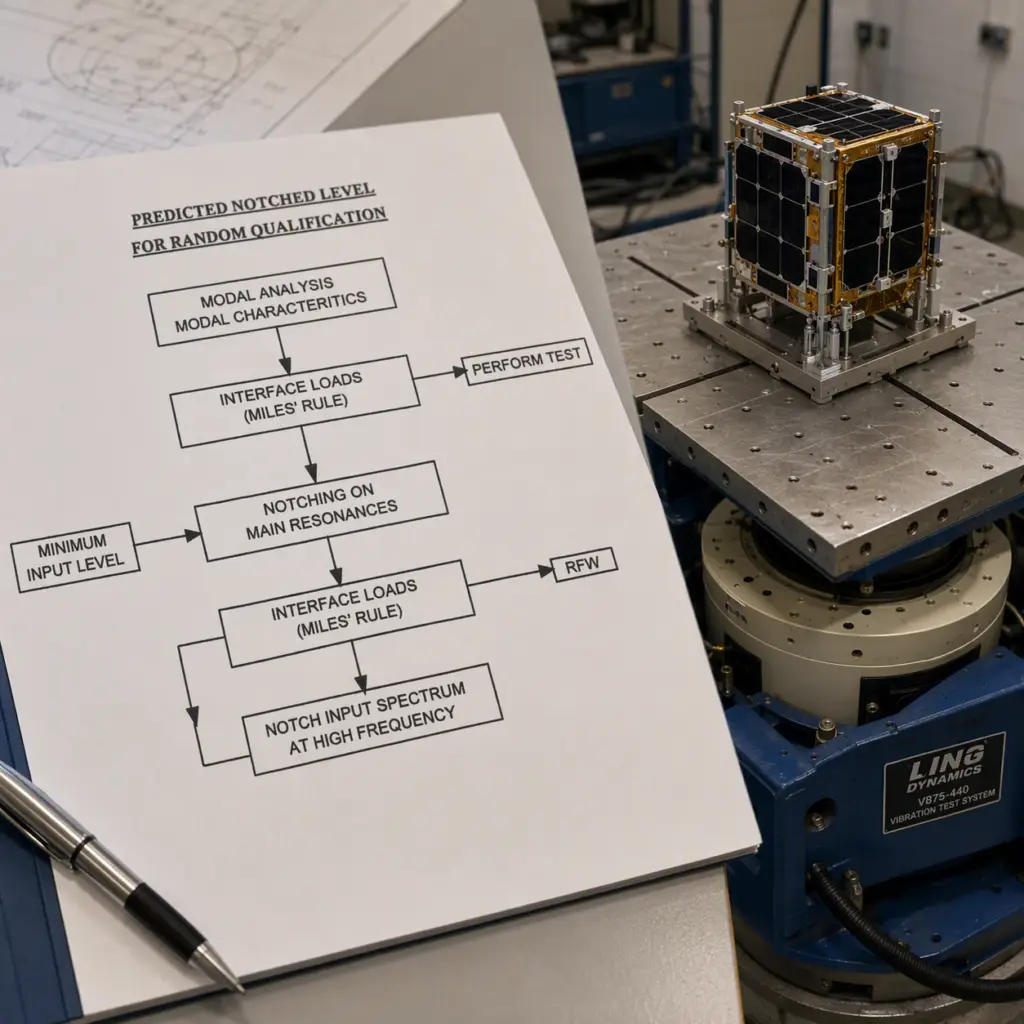
Typical Notching Process
Planning
Identify resonances through analysis and modal assessment.
Preparation
Define instrumentation (including response accelerometer locations), damping assumptions and interface load limits.
Execution
Apply controlled notches during sine or random vibration testing.
Review
Assess measured responses and confirm interface load compliance.
Closure
Document final notch levels, results and verification evidence.
Key Activities
-
Modal analysis
-
Damping assessment
-
Interface load calculation
-
Random vibration notching
-
Sine vibration notching
-
Measurement planning
-
Test correlation activities
The Physics Of Notching
Why Resonances Create High Loads
When a structure is excited at one of its natural frequencies, the vibration response can become significantly larger than the applied input. This phenomenon is known as dynamic amplification.
A simple example is a child on a swing. Small pushes applied at the correct frequency create large motions. Space hardware behaves similarly during vibration testing.
The amplification factor is influenced by:
-
Natural frequency
-
Structural damping
-
Modal mass
-
Excitation level
-
Boundary conditions
Near resonance, a relatively small shaker input can generate very large interface forces.
The Relationship Between Input And Response
A vibration test specification defines the input applied by the shaker.
The hardware responds according to its dynamic characteristics.
Input acceleration ≠ structural load
In many cases the highest structural loads occur because the hardware amplifies the shaker input through resonance.
This is why engineers monitor:
-
Input control accelerometers
-
Response accelerometers
-
Interface loads
-
Strain measurements
Notching is often driven by response rather than input.
Why Interface Loads Matter
Launch vehicle environments are normally specified as acceleration levels.
Hardware failure, however, occurs because of force and stress.
A resonant structure may experience interface forces significantly greater than those predicted from input acceleration alone.
Notching is therefore used to control force rather than simply control acceleration.
How Notching Works
At frequencies where excessive interface loads are predicted or measured, the vibration input is reduced.
The resulting notch:
-
Reduces force transmission
-
Limits dynamic amplification
-
Protects flight hardware
-
Maintains realistic verification conditions
The objective is not to make the test easier.
The objective is to prevent unrealistic overtesting.
The Engineering Balance
The challenge with notching is balancing two competing objectives:
-
Test hard enough to verify the design.
-
Avoid creating loads that would never occur in flight.
Too little notching can damage hardware.
Too much notching can invalidate the test.
Good notching is therefore a structural dynamics exercise rather than a test laboratory adjustment.
The Difference Between Response Limiting And Notching
Many engineers use the terms response limiting and notching interchangeably. Although closely related, they are not the same process.
What Is Notching?
Notching is a pre-defined reduction in vibration input at specific frequencies before the test begins. The notch profile is typically derived from structural analysis, modal testing, interface load predictions or previous test data.
The objective is to prevent excessive loads from occurring during the test.
Example:
A resonance is identified at 180 Hz.
Analysis predicts interface loads exceeding qualification limits.
The input spectrum is reduced around 180 Hz.
Testing proceeds using the modified spectrum.
What Is Response Limiting?
Response limiting is an active control process performed during testing. Instead of relying solely on the shaker control accelerometer, additional control response channels monitor structural response or interface loads in real time.
Example:
A response accelerometer is installed on a sensitive avionics enclosure.
During the test the response reaches a predefined limit.
The vibration controller automatically reduces shaker input.
The response remains below the allowable threshold.
Key Difference
| Method | Characteristic |
|---|---|
| Notching | Predictive |
| Response limiting | Reactive |
Notching uses analysis to anticipate problems.
Response limiting uses measurements to prevent problems.
Many modern spacecraft vibration tests employ both techniques simultaneously.
Engineering Consideration
Response limiting can provide greater confidence because it is based on measured hardware behaviour rather than analytical prediction alone.
However, response limiting requires additional instrumentation, careful setup and clear acceptance criteria.
Dynamic Amplification Factor Explained
One of the most important concepts in vibration testing is Dynamic Amplification Factor, or DAF.
DAF describes how much larger a structure’s response becomes compared with the applied input.
Why Does Amplification Occur?
Every structure possesses natural frequencies.
When excitation occurs near one of these frequencies, energy accumulates within the structure.
The resulting vibration level can become significantly larger than the original input.
This phenomenon is resonance.
Simple Example
| Parameter | Value |
|---|---|
| Input acceleration | 1 g |
| Measured structural response | 12 g |
| Calculation | DAF = Response ÷ Input |
| Result | DAF = 12 |
The structure is amplifying the input by a factor of twelve.
What Influences DAF?
-
Structural damping
-
Natural frequency
-
Modal mass
-
Joint stiffness
-
Boundary conditions
-
Mounting configuration
The Role Of Damping
Highly damped structures dissipate energy efficiently.
Lightly damped structures store energy and exhibit much larger resonant responses.
This explains why lightweight aerospace structures often require careful notching and response limiting strategies.
Why Engineers Care About DAF
Large DAF values can generate interface loads much higher than flight predictions.
A qualification test that ignores amplification effects may unintentionally become a structural proof test.
Understanding DAF helps engineers:
-
Predict interface loads
-
Develop notch strategies
-
Set response limits
-
Protect expensive hardware
-
Improve correlation between analysis and test
Interface Loads vs Input Acceleration
One of the most common misconceptions in vibration testing is that shaker acceleration determines structural severity.
In reality, hardware fails because of loads and stresses.
Input Acceleration
Input acceleration is the vibration level commanded by the shaker.
Examples include:
-
20 g sine vibration
-
14.1 Grms random vibration
-
Specified launch vehicle PSD environments
Input acceleration describes the environment applied to the test item.
It does not directly indicate structural stress.
Interface Loads
Interface loads are the forces and moments transferred through the mounting points connecting the hardware to the spacecraft, launch vehicle or test fixture.
These loads drive structural stress.
Engineers therefore pay close attention to:
-
Axial force
-
Shear force
-
Bending moment
-
Torsional moment
Why High Loads Occur At Resonance
Newton’s Second Law states:
Force = Mass × Acceleration
When acceleration increases because of resonance, force increases accordingly.
A modest shaker input may therefore generate very large interface loads.
Example:
| Parameter | Value |
|---|---|
| Equipment mass | 20 kg |
| Input acceleration | 1 g |
| Response acceleration | 15 g |
| Increase in resulting force | Factor of fifteen |
This is why interface loads often become the primary driver for notching decisions.
The Engineering Objective
The objective of vibration testing is not to maximise acceleration.
The objective is to reproduce realistic flight loads while maintaining verification confidence.
Well-executed notching allows engineers to:
-
Control interface loads
-
Prevent unrealistic overtesting
-
Protect flight hardware
-
Maintain representative verification conditions
Common Risks and Challenges
Technical Risk
Incorrect notch levels may result in overtesting or undertesting.
Schedule Risk
Additional analysis and review cycles can affect programme schedules.
Cost Risk
Extra instrumentation and modelling effort may increase project costs.
Verification Risk
Insufficient evidence may compromise verification acceptance.
Documentation Risk
Poor justification or traceability can delay approval.
Best Practices
-
Maintain configuration control
-
Ensure requirement traceability
-
Use calibrated test equipment
-
Perform independent technical reviews
-
Correlate analysis and test data
-
Document all notch assumptions and approvals
What Not To Do When Applying Notching
Do Not Use Notching To Hide Structural Weaknesses
Notching should never be used to compensate for inadequate structural design. If excessive notching is required, the root cause may be insufficient stiffness, poor load paths or inadequate structural margins.
Do Not Apply Notches Without Understanding The Resonance
Every notch should be linked to an identified structural mode, measured response or validated analysis. Applying arbitrary notches introduces verification risk and reduces confidence in test results.
Do Not Over-Notch The Test
Excessive notch depth or bandwidth can remove important flight-like energy from the test environment. This may result in undertesting and reduced verification confidence.
Do Not Ignore Damping Assumptions
Incorrect damping values can significantly affect calculated amplification factors and interface loads. Damping assumptions should be supported by analysis or test evidence.
Do Not Rely Solely On Analysis
Where practical, analytical predictions should be supported by modal surveys, low-level sine testing or measured response data.
Do Not Forget Configuration Control
Changes to mounting arrangements, mass properties or hardware configuration can invalidate previously approved notch profiles.
Do Not Skip Post-Test Verification
Low-level signature sweeps before and after testing help confirm that no structural changes or hidden damage occurred during the campaign.
Do Not Assume Smaller Hardware Does Not Need Attention
For smaller equipment, local dynamic responses at higher frequencies may become more critical than global modes and should not be overlooked.
Related Documentation
-
Verification Plan
-
AIT Plan
-
Test Specification
-
Test Procedure
-
Test Report
-
Verification Control Document
-
NCRs and RFWs
How Success Is Measured
-
Requirement compliance achieved
-
Interface loads remain within limits
-
No hardware damage following testing
-
Verification evidence accepted
-
Flight readiness supported
How Resonate Testing Supports Notching
-
Verification planning support
-
Structural dynamics guidance
-
Vibration test campaign development
-
Documentation and reporting support
-
Independent technical review
-
Qualification and acceptance test assistance
Frequently Asked Questions
What is vibration test notching?
A method of reducing vibration input levels at specific resonances to control structural loads.
Why is notching used?
To prevent unrealistic overtesting while maintaining verification objectives.
Is notching allowed under ECSS?
Yes, when technically justified and properly documented.
How are notch levels determined?
Using structural analysis, modal testing and interface load assessments.
Can notching be applied to both sine and random testing?
Yes, provided the methodology is technically justified.
Related Articles
Verification Philosophy
-
Qualification Testing Under ECSS
-
Acceptance Testing Under ECSS
-
Protoflight Testing
-
Model Philosophy
-
EQM vs PFM vs FM
Environmental Testing
-
Vibration Testing
-
Thermal Vacuum Testing
-
EMC Testing
-
Acoustic Testing
-
Shock Testing
Programme & Verification
-
Verification Planning
-
Verification Matrices
-
Verification Evidence
-
Environmental Testing
-
Space Qualification Process
Reviews & Documentation
-
Test Readiness Reviews
-
AIT Plans
-
Test Specifications
-
Test Reports
Need Support With Vibration Test Notching?
Need support with vibration testing, structural dynamics or ECSS verification? Contact Resonate Testing for independent guidance on notching strategies, qualification testing and flight hardware verification.
Your Test Facilitator. Not simply a test facility.