
© 2026 ResonateTesting Ltd.
Engineer-led thermal cycling under vacuum, with controlled test planning, monitoring and reporting aligned to project-specific ECSS requirements.
ECSS-Q-ST-70-04C programmes translate a project requirement into a controlled thermal-vacuum procedure, traceable chamber data, inspection results and a report assessed against agreed acceptance criteria.
ECSS-Q-ST-70-04C defines requirements for specifying, performing and reporting thermal cycling under vacuum. It applies to materials, processes, mechanical parts and assemblies intended for spacecraft and associated equipment.
 Vibration testing
 Shock testing
 Environmental testing
 Humidity testing
 Rain and Water Ingress testing
Early review should confirm the test item’s identity and condition, the applicable project specification, chamber fit, mounting, temperature measurement, vacuum level, contamination controls and acceptance criteria.
The customer and test authority agree the temperature range, measurement method, vacuum conditions, cycle profile, contamination monitoring and examinations. Actual sample temperature—not chamber set-point alone—must be measured.
Informative Annex D describes a reference method of 1 × 10⁻⁵ Pa, cycling between +100 ±5°C and −100 ±5°C, nominal transitions of 10 ±2°C/min, at least five minutes at each extreme and at least 100 cycles. These values are not an automatic universal profile; the approved project requirements govern.
ECSS-Q-ST-70-04C programmes evaluate space materials, processes, mechanical parts and assemblies across a controlled sequence of temperature transitions and dwells under vacuum.
Test planning is based on the approved project requirements, including the temperature range, cycle count, transition rate, dwell periods, mounting, instrumentation, contamination controls, inspections and acceptance criteria.
| Record | Purpose |
|---|---|
| Annex A test request | Defines the item, programme need and requested conditions. |
| Annex B proposal and procedure | Controls preparation, equipment, profile, monitoring and inspections. |
| Annex C test report | Records the actual procedure, results, discussion and conclusion. |
| Nonconformance records | Capture deviations, suspected failures and agreed disposition. |
| Standard / Guidance | Primary Focus | Typical Relevance |
|---|---|---|
| NASA Thermal Vacuum Guidance | European environmental qualification standard for airborne equipment (harmonised with RTCA DO-160) | Aerospace qualification programmes, European aviation certification activities and airborne equipment testing |
| NASA GSFC-STD-7000B (GEVS) | FAA guidance for the use of RTCA DO-160 environmental qualification data | Airworthiness compliance, certification planning and environmental qualification acceptance |
| ECSS-Q-ST-70-04C | Development guidelines for civil aircraft and aircraft systems | Aircraft system development, validation, verification and certification programmes |
| ECSS-Q-ST-70-02C | Safety assessment process for airborne systems and equipment | Functional hazard assessment, system safety assessment and aerospace risk management |
ECSS-Q-ST-70-04C testing needs more than chamber access. It requires an agreed procedure, controlled conditions, useful monitoring and evidence that can be traced back to the project’s acceptance criteria. Resonate provides engineer-led support from the first requirements review through test execution and reporting.
We review your specification, hardware, thermal-vacuum profile, fixturing, feedthroughs, instrumentation and acceptance criteria before the test begins.
TVAC can be coordinated with vibration, shock and wider environmental testing at one facility, reducing transport, repeated handling and fragmented scheduling.
Agreed temperatures, vacuum conditions, functional data, inspections, deviations and results are captured in a controlled report aligned with the approved scope.
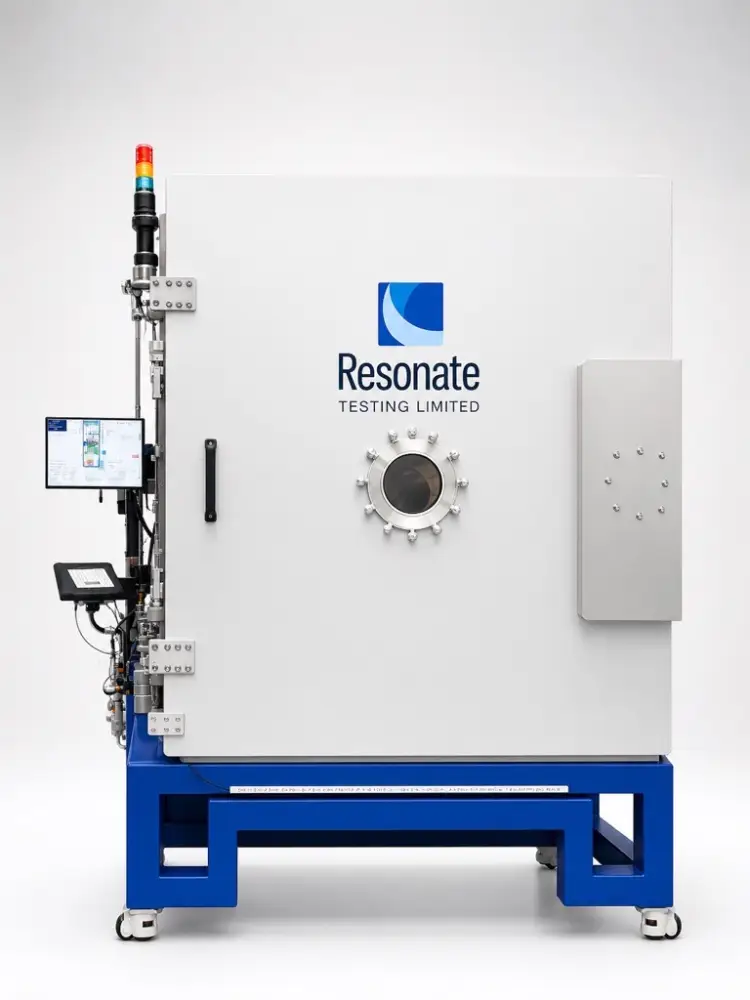
Your test facilitator—not simply a test facility. Our engineers help translate customer and project requirements into a practical, facility-ready programme while you retain control of the verification and acceptance strategy.
Resonate Testing can review the requirement, assess chamber fit, plan fixtures and feedthroughs, instrument the test item, execute thermal cycling and provide telemetry, observations and an agreed report or data pack.
Programmes can include sample-temperature measurement, pressure data, functional monitoring and contamination planning. Customer-specified pre-test and post-test evaluation can include visual inspection, photomicrographs and thermo-optical, mechanical, surface or electrical measurements.
Acceptance criteria are agreed before testing. A sample passes when it meets those criteria and is not damaged by the approved procedure. Cracking, fracture, overheating, significant electrical degradation and other suspected failures are documented and handled through the project nonconformance process.
The complete range of environmental conditions that equipment may encounter throughout operation, ground handling and storage.
Categories are typically selected based on the aircraft type, installation location, operating environment and customer or regulatory requirements.
No. Most programmes are tailored to the intended airborne application and only include the sections relevant to the equipment being qualified.
Equipment installed in a cockpit, avionics bay, external pod, rotorcraft compartment or UAV platform may experience very different environmental conditions requiring different category selections.
Typical inputs include the RTCA DO-160 revision, aircraft platform, installation location, equipment drawings, environmental requirements, operating modes and acceptance criteria.
RTCA DO-160 is an environmental qualification standard used to evaluate how airborne equipment performs when exposed to the environmental conditions encountered during aviation operations.
No. RTCA DO-160 is a test standard that provides environmental qualification procedures and categories. Testing generates evidence that may support certification and approval activities.
RTCA DO-160 is commonly applied to avionics, communication equipment, navigation systems, sensors, UAV payloads, eVTOL technologies, aerospace batteries and other airborne electronic systems.
The standard helps demonstrate that airborne equipment can operate reliably when exposed to environmental, mechanical and electromagnetic conditions encountered during aircraft service.
Programme duration depends on the selected test sections, environmental severities, functional monitoring requirements and qualification objectives.
Yes. Temperature, altitude, vibration, shock, waterproofness, EMC and other applicable assessments are often coordinated within a single qualification programme.
Monitoring requirements vary by programme but may include functional checks, operational assessments, electrical monitoring, environmental measurements and post-test inspections.
Customers typically receive environmental test records, achieved environmental profiles, observations, functional assessment data, inspection findings and an agreed qualification report or data pack aligned with the programme scope.
Share the standard, drawing, equipment description or draft test profile. A test engineer can review the requirement, confirm the practical route, identify unsupported or partner-supported areas, and help define fixtures, instrumentation, sequence and reporting needs before testing starts.
Whether you’re looking to contact us for the first time or have another testing requirement, we’d love to hear from you.